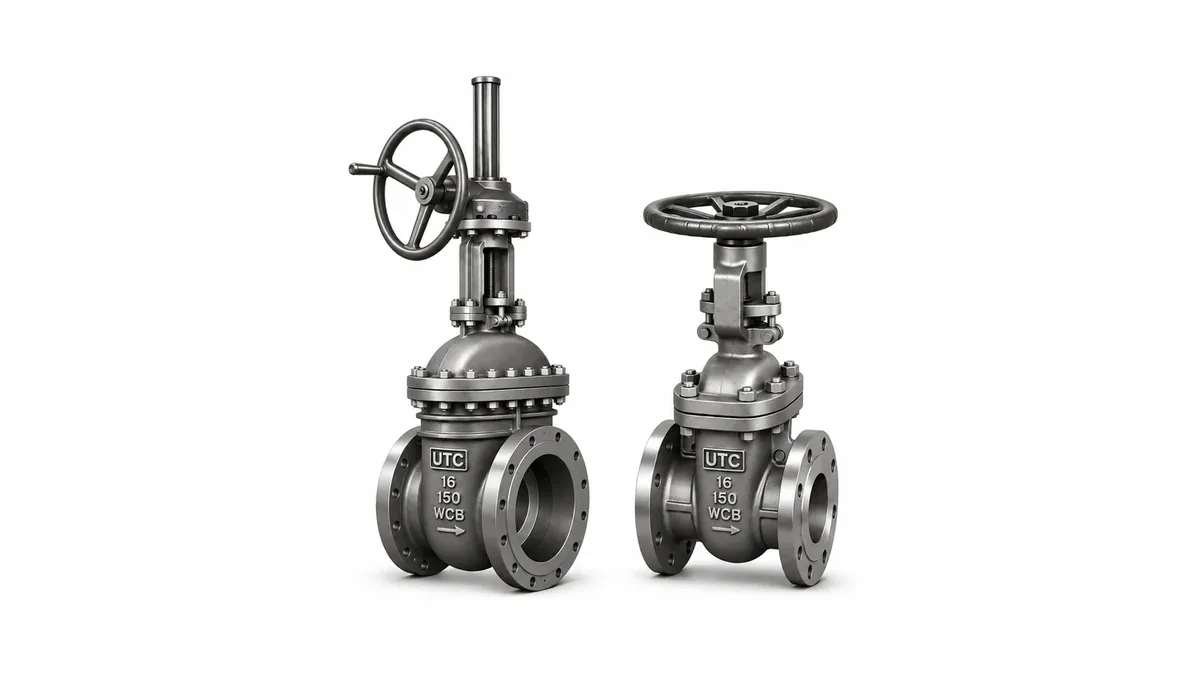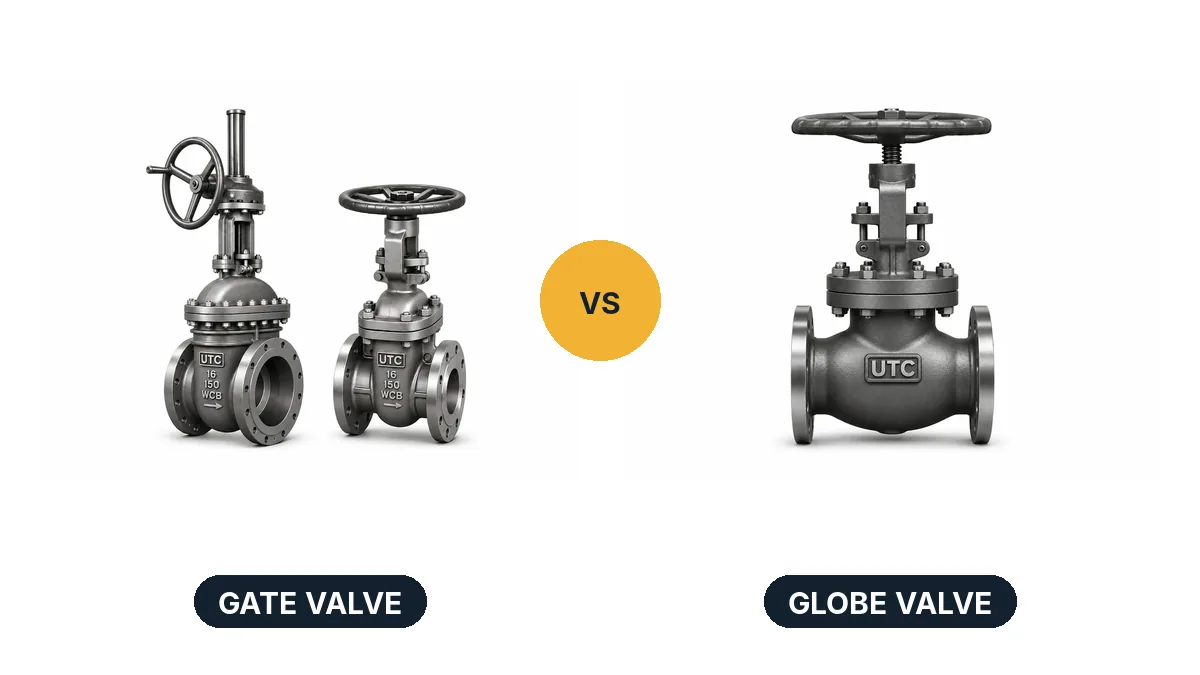
Gate valves and globe valves are both linear-motion valves, and both appear on almost every piping specification. Yet they behave very differently once the line is in service. One is built to open fully and get out of the way. The other is built to control the opening and accept some pressure loss in return.
This comparison explains how each valve works, where it performs best and where it does not, so that the right one is written into the specification.
How a gate valve works
In a gate valve, a wedge or gate moves at right angles to the flow. When the valve is fully open, the gate is withdrawn into the bonnet and the bore is clear. Sealing is achieved by the gate pressing against the seat rings, helped by line pressure on the downstream side.
Because the flow path is straight, pressure drop across a fully open gate valve is low. The disadvantage is that the gate must travel a long distance, so operation is slow and the valve is tall when the stem rises.
How a globe valve works
In a globe valve, the disc moves along the axis of the stem toward a seat that sits in a partition inside the body. Flow enters, turns through the seat opening and turns again on the way out. As the disc approaches the seat, flow area reduces gradually, which makes the valve suitable for regulation.
Z-pattern bodies are the most common. Y-pattern bodies give a straighter path and lower pressure drop, and angle patterns replace an elbow and valve in a single body.
Side-by-side comparison
| Parameter | Gate valve | Globe valve |
|---|---|---|
| Primary duty | On-off isolation | Isolation and flow regulation |
| Throttling | Not recommended | Suitable |
| Pressure drop when open | Low | Higher |
| Stem travel | Long | Short |
| Operating speed | Slow | Faster per turn count, more turns per mm of flow change |
| Seat wear when partly open | High risk | Designed for it |
| Typical sealing | Wedge against seat rings | Disc against seat |
| Typical cost at the same size | Often lower in large sizes | Often higher in large sizes |
These are general tendencies. Actual performance depends on the specific design, the materials and the trim.
Where gate valves are preferred
- Pipeline and manifold isolation where the valve rarely moves
- Tank farm and terminal lines where low pressure drop matters
- Large-diameter water and cooling lines
- Steam header isolation, using a flexible wedge design
- Any line where full-bore flow is required
See our gate valves page for configurations.
Where globe valves are preferred
- Boiler feedwater and steam lines where some regulation is needed
- Control valve bypass lines
- Fuel oil, lube oil and chemical dosing lines
- Drain, vent and sampling duties
- Services where tight shut-off is needed and the valve is cycled often
Our globe valves page lists the body patterns and trims.
Maintenance considerations
In a globe valve, the disc and seat can often be lapped or replaced in place, depending on the design. In a gate valve, wedge and seat ring wear shows up as leakage that is harder to correct without removing the valve. On the other hand, a gate valve left fully open or fully closed for long periods has few moving wear points.
Both valves rely on packing. Check the stem condition and the packing gland regularly, and follow the manufacturer’s torque guidance.
Installation and orientation
Gate valves are usually bidirectional, although some designs have a preferred flow direction. Globe valves normally have a flow arrow on the body and must be installed accordingly. Many are designed for flow under the seat, but this depends on the design and on the service, so follow the marking and the data sheet.
Standards and ratings
Steel gate valves are commonly specified to API 600, and steel globe valves to API 623 or BS 1873, with small forged valves to API 602. Pressure–temperature ratings follow ASME B16.34, and testing commonly follows API 598. See our guide to API 600 and API 602 for the gate valve side.
Flow behaviour and pressure loss
The difference in pressure loss between the two valves can be significant in long or high-flow lines. A fully open gate valve has a flow path close to that of the pipe, so the loss is small. A globe valve forces the flow through two changes of direction, so its flow coefficient is lower at the same size. Always compare the flow coefficient (Cv or Kv) on the manufacturer’s data sheet rather than relying on general rules, because Y-pattern globe valves and full-port designs behave differently from standard Z-pattern bodies.
In pumped systems, the extra pressure loss from globe valves adds to pump head and energy use over time. In a line that is isolated rarely, a gate valve avoids that penalty entirely.
Life-cycle view instead of purchase price
Purchase price is only part of the cost. A gate valve used for throttling may leak within months and need replacement, while a globe valve used on a clean isolation duty may cost more than necessary and add to pressure loss. Consider the cost of ownership: energy loss through pressure drop, maintenance access, spare parts and the consequences of leakage. For critical lines, a modest increase in valve cost can be far cheaper than an unplanned shutdown.
Common specification mistakes
- Writing “gate or globe” on a data sheet without defining the duty
- Specifying a gate valve for a control bypass that will be throttled
- Leaving the flow direction unspecified for globe valves
- Ignoring trim hardness where erosive or abrasive media are present
- Forgetting to state the end connection standard
A clear duty description, with the operating frequency and whether regulation is needed, resolves most of these before the order is placed.
Making the choice
If the valve will be opened or closed and left, and low pressure drop is important, choose a gate valve. If the valve needs to regulate flow, will be operated often or needs good seat access for maintenance, choose a globe valve. If you are not sure, send the duty and operating conditions with your quotation request and ask for a recommendation.
Frequently asked questions
Which valve has lower pressure drop?
A fully open gate valve has a lower pressure drop because the flow path is straight through the bore.
Can a globe valve be used for isolation only?
Yes. Globe valves seal well, and are often used for isolation on smaller lines, but they create more pressure drop than a gate valve.
Why is a gate valve not used for throttling?
Partially open gates are exposed to high-velocity flow, which can cause vibration and seat erosion.
Are gate and globe valves available in forged steel?
Yes. Forged steel gate and globe valves are common in small sizes, often built to API 602.
References and further reading
Standards and codes are published by their issuing bodies. Always use the current edition named in your project specification.