Ball valves and butterfly valves are both quarter-turn valves. Both open and close quickly and both are easy to automate, so they often compete for the same position on a drawing. The right choice depends on size, pressure, temperature, tightness and cost, rather than on any single advantage.
This article compares the two designs and explains the situations where each normally makes more sense.
How a ball valve works
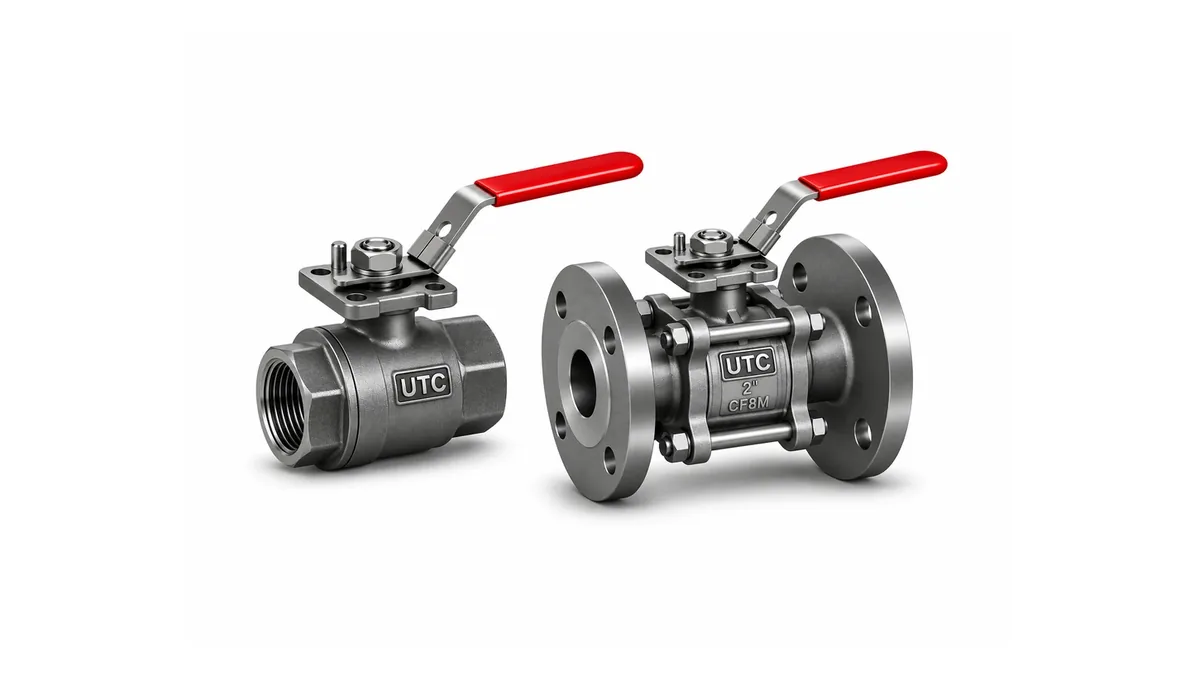
A ball valve contains a spherical closure with a bore through the centre. Turning the stem through 90 degrees aligns the bore with the pipe or rotates it out of the way. A full-bore design has a bore equal to the pipe, giving very low pressure drop, while a reduced-bore design has a smaller bore and a lower cost.
In a floating ball valve, line pressure pushes the ball against the downstream seat to seal. In a trunnion-mounted valve, the ball is supported by trunnions, so seat loads and operating torque are lower on larger sizes and higher pressure classes. Seats may be polymer or metal, depending on the temperature and the fluid.
How a butterfly valve works
A butterfly valve has a disc mounted on a shaft in the centre of the pipe bore. Rotating the shaft turns the disc from parallel to perpendicular to the flow. The disc remains in the flow path even when fully open, which creates some pressure drop. Designs include resilient-seated concentric valves, double-offset (high-performance) valves and triple-offset valves.
Comparison at a glance
| Parameter | Ball valve | Butterfly valve |
|---|---|---|
| Operation | Quarter-turn | Quarter-turn |
| Pressure drop (open) | Very low in full-bore | Low to moderate; disc stays in flow |
| Shut-off tightness | Very good, soft or metal seats | Good in resilient-seated; high-performance designs improve tightness |
| Typical size range | Small to medium, large with trunnion designs | Medium to very large |
| Weight and space | Heavier and longer in large sizes | Light and compact, short face-to-face |
| Throttling | Limited, seat wear risk | Common in some designs |
| Cost in large sizes | Higher | Lower |
These are general tendencies; individual designs differ.
When a ball valve is the better choice
- Oil, gas and process lines needing reliable tight shut-off
- Services with higher pressure classes
- Lines that are pigged or need full-bore flow
- Applications where leakage standards are strict
- Frequent operation in small and medium sizes
Browse our ball valves page for the floating and trunnion configurations we supply.
When a butterfly valve is the better choice
- Large-diameter water, cooling and low-pressure lines
- Locations where weight and space are limited
- Projects where cost per size is a priority
- Services with moderate pressure and temperature
- Applications where modulating duty is needed and the design supports it
Butterfly valves are commonly built to API 609 for wafer, lug and double-flanged designs; confirm the standard named in your specification.
Material and sealing considerations
Seat material limits pressure and temperature. Soft seats seal very tightly but have temperature limits. Metal seats tolerate higher temperatures and abrasive fluids but need tighter manufacturing control to seal. For fire-risk services such as hydrocarbons, ask whether fire-safe design and testing is required under your specification and confirm it with the supplier, since documentation requirements vary.
Operating torque and actuation
Both valve types are well suited to actuation. A butterfly valve’s torque varies with disc position and differential pressure, and a ball valve’s torque is highest at breakaway. Actuator sizing should be based on the valve data supplied and a suitable safety margin.
Flow characteristics and pressure drop
A full-bore ball valve gives a clear passage almost equal to the pipe diameter, so the flow coefficient is high and pressure loss is low. A butterfly valve’s disc remains in the flow, which adds resistance, especially in smaller sizes and in designs with a thick disc profile. In large lines, this loss may be acceptable, and the weight and cost savings often outweigh it. In long pumped lines with high flow, the cumulative pressure loss may influence the choice.
For modulating duty, butterfly valves have a characteristic that approaches equal-percentage behaviour in some designs, while ball valves with standard bores behave more like quick-opening valves. Special V-port ball valves are available for control duty. If regulation is required, ask for the valve’s flow characteristic and suitable actuator.
Maintenance and service life
Seat and seal wear is the main maintenance issue in both valve types. Soft seats in ball valves can be damaged by abrasive solids or by operating against debris, and the ball’s surface finish matters for seal life. Butterfly valve seats can be damaged if the disc is closed against build-up in the line. Regular operation in lines that are rarely cycled, partial stroke testing where suitable, and flushing before commissioning all help.
Trunnion ball valves are generally heavier but can offer long service in high-pressure hydrocarbon lines. Resilient-seated butterfly valves are often cheaper to replace in water and cooling systems. Consider the cost and difficulty of removing the valve during shutdowns as part of life-cycle planning.
Typical applications by industry
| Industry | Typical ball valve use | Typical butterfly valve use |
|---|---|---|
| Oil and gas | Pipeline and process on-off isolation | Utility water and fire water lines |
| Power generation | Instrument and auxiliary lines | Cooling water circuits |
| Water and wastewater | Smaller isolation points | Large-diameter mains and pump stations |
| Chemical processing | Isolation of process lines, where materials are suitable | Cooling and utility systems |
These are common patterns and not rules; the service conditions and the plant specification always decide. See our industries page for the sectors we support.
A simple decision approach
- Fix the size, pressure class and temperature.
- If the size is large and the pressure is moderate, shortlist butterfly valves.
- If shut-off tightness, pressure or full-bore flow is critical, shortlist ball valves.
- Check the standard, seat material and fire-safe requirements.
- Compare lifecycle cost, not purchase price alone.
If you need isolation with a straight-through bore at lower speed, a gate valve remains an option. For regulation, review a globe valve. When ready, send your data via Request a Quote.
Frequently asked questions
Is a ball valve or a butterfly valve better for shut-off?
Ball valves usually offer tighter shut-off, especially at higher pressures. Resilient-seated and high-performance butterfly valves can also seal well within their limits.
Are butterfly valves suitable for high pressure?
High-performance butterfly valves can handle higher pressures, but ball valves are generally preferred for higher pressure classes.
What is a trunnion ball valve?
A ball valve in which the ball is held by trunnions, reducing seat loads and operating torque, which helps in larger sizes and higher pressures.
Can butterfly valves be used for throttling?
Some designs are used for modulating duty. Check the design suitability and the required control characteristic.
References and further reading
Standards and codes are published by their issuing bodies. Always use the current edition named in your project specification.