Every process line needs valves to start, stop, regulate, protect or direct flow. The difficulty for engineers and buyers is not finding a valve; it is matching the right type to the duty. A gate valve that is perfect for pipeline isolation can be a poor choice for throttling, and a check valve that works well in a clean water line can chatter in a pulsating service.
This guide walks through the main families of industrial valves, explains how each one works, and shows where each is normally used. It is written as a starting point for selection. Final choices always depend on the fluid, pressure, temperature, size, operating frequency and the project specification.
How industrial valves are classified
Valves can be grouped in two useful ways. The first is by motion of the closure element. In linear-motion valves, such as gate and globe valves, the stem moves the closure in a straight line. In quarter-turn valves, such as ball, plug and butterfly valves, the closure rotates through roughly 90 degrees between open and closed.
The second grouping is by function. Some valves isolate a line, some regulate flow, some prevent reverse flow, and some protect equipment from overpressure. Thinking in terms of function first usually narrows the choice to two or three valve types very quickly.
Isolation valves: gate, ball and butterfly
Isolation valves are intended to be fully open or fully closed. They carry flow with as little pressure loss as possible and shut it off reliably when required.
Gate valves
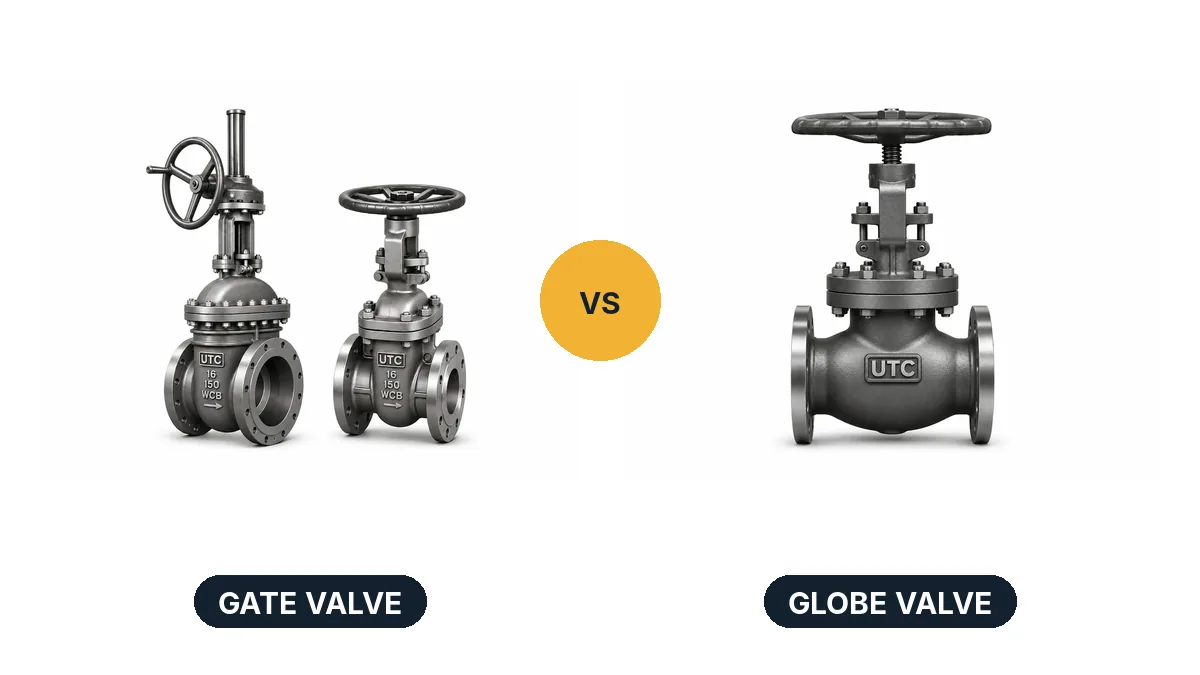
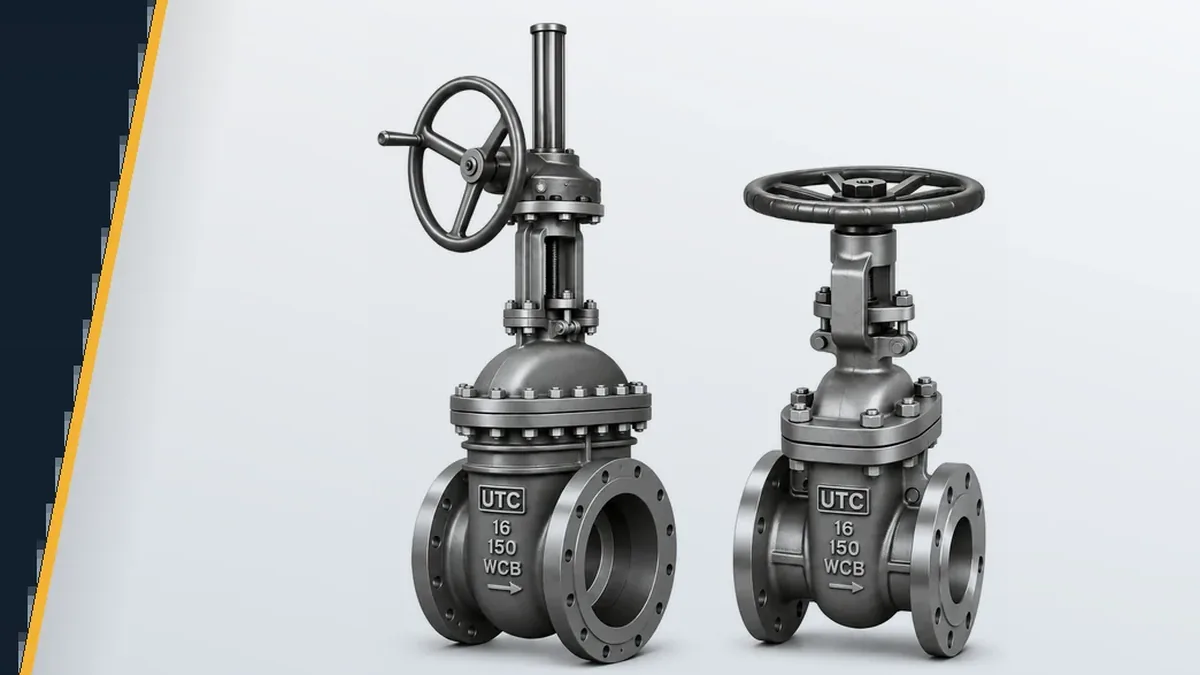
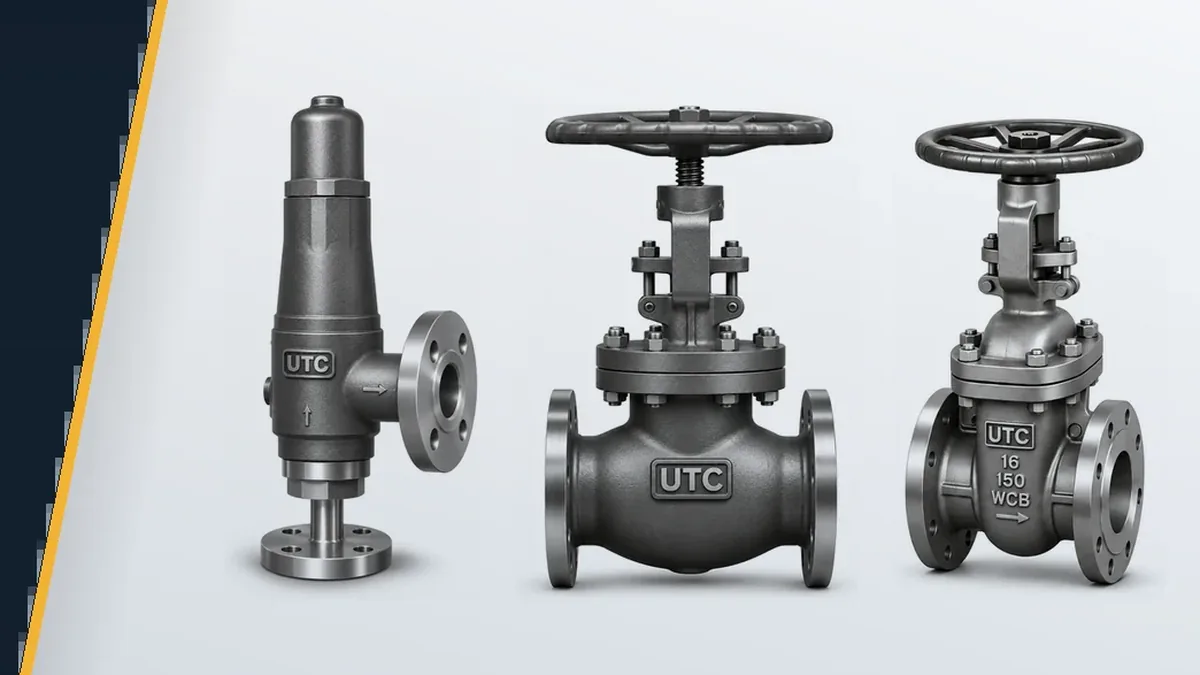
A gate valve lifts a wedge or gate out of the flow path, leaving a straight-through bore when open. Pressure drop is low, which is why gate valves are used widely on pipelines, tank farm lines, steam headers and cooling water systems. They are slow to operate and are not meant for throttling. See our guide on how to select a gate valve for the main selection points.
Ball valves
A ball valve uses a rotating ball with a bore through it. A quarter-turn gives fast operation and, in good designs, tight shut-off. Floating and trunnion-mounted designs are common, with trunnion-mounted valves generally used for larger sizes and higher pressure classes. Ball valves suit on-off duty in oil, gas and process lines. Our ball valves page lists the configurations we supply.
Butterfly valves
A butterfly valve turns a disc on a central shaft. They are compact and light for their size, which makes them attractive on large-diameter water, cooling and low-pressure lines. For a direct comparison, read ball valve vs butterfly valve.
Regulation valves: globe valves
A globe valve moves a disc onto or away from a seat, so flow changes progressively with stem travel. That makes it suitable for throttling and for services where the valve is operated often. The price is a higher pressure drop, because the flow changes direction inside the body. Globe valves are common on boiler feedwater, steam, fuel oil and control valve bypass lines. Our comparison of gate valve vs globe valve explains the trade-offs in more detail.
Non-return valves: check valves
A check valve opens with forward flow and closes automatically when flow reverses. No external operator is needed. Swing, lift, dual-plate and piston designs are all used, and each behaves differently under low flow, pulsation or rapid reversal. Check valves are fitted at pump discharges, compressor outlets and wherever backflow could damage equipment. The article on choosing a check valve covers the design differences.
Protection devices: safety and relief valves
Safety and relief valves open at a set pressure to release fluid and protect vessels and piping from overpressure, then reclose once the pressure falls. They are a last line of defence and are selected and sized against the applicable code and the relieving scenario. Read more in what safety relief valves are and how they work.
Auxiliary protection: strainers
A strainer is not a valve, but it sits alongside valves in most piping systems. A Y-type strainer catches debris upstream of pumps, meters, control valves and steam traps. Our guide to the Y-type strainer explains how to size and position one.
Quick comparison of common valve types
| Valve type | Main function | Typical operation | Pressure drop (open) | Common uses |
|---|---|---|---|---|
| Gate | Isolation | Multi-turn, slow | Low | Pipelines, tank farms, steam headers |
| Globe | Regulation and isolation | Multi-turn | Higher | Feedwater, steam, fuel oil, bypass lines |
| Ball | Isolation | Quarter-turn, fast | Low (full bore) | Oil, gas and process on-off duty |
| Butterfly | Isolation, some regulation | Quarter-turn | Low to moderate | Large-diameter water and cooling lines |
| Check | Prevent reverse flow | Automatic | Low to moderate | Pump and compressor discharge |
| Safety / relief | Overpressure protection | Automatic at set pressure | Not applicable | Vessels, boilers, pipelines |
How to choose between valve types
Start with the duty: isolate, regulate, prevent backflow or protect. Then check the service conditions: fluid, design pressure and temperature, and whether solids or corrosive species are present. Confirm the size and pressure class, the end connections and the material grade. Finally, consider operation: how often the valve moves, whether it needs a gear box or actuator, and how fast it must close.
Standards also guide the choice. Common references include ASME B16.34 for pressure–temperature ratings, API 600 for steel gate valves, API 598 for inspection and testing, and API 526 for flanged steel pressure relief valves. Always follow the edition and requirements named in your project specification.
Other valve types you may meet
Several other valve families appear in process plants alongside the ones above. Plug valves use a tapered or cylindrical plug and are common in gas distribution and some chemical services. Needle valves have a slender, tapered stem for fine flow adjustment on small instrument and sampling lines. Diaphragm valves isolate the moving parts from the fluid with a flexible diaphragm, which suits clean, corrosive or slurry services. Control valves are fitted with an actuator and positioner to hold a process variable such as flow, pressure or level.
These types serve narrower duties than the core range, but they follow the same logic: define the function first, then check the conditions, then confirm the standard and material.
Working with a supplier
A clear enquiry saves time. Include valve type, size, pressure class, body and trim materials, end connections, operator, service fluid, design conditions and the governing standard. If you are unsure which type fits, share the duty and conditions and ask for a recommendation. You can browse our full valve range or go straight to a quotation request.
Frequently asked questions
What is the difference between a gate valve and a globe valve?
A gate valve is intended for full open or full closed isolation with low pressure drop. A globe valve can regulate flow and is operated more often, but it creates a higher pressure drop.
Which valve is best for fast shut-off?
Quarter-turn valves such as ball and butterfly valves close in a fraction of the time that multi-turn gate or globe valves need. The right choice still depends on pressure, temperature and the tightness required.
Do all valves need a pressure class?
Steel valves built to ASME B16.34 are assigned a pressure class, such as 150, 300 or 600. The class defines the allowable pressure at each temperature for the material group used.
Can one valve type be used for every service?
No. Each type is designed for particular duties, so mixing up isolation, regulation and non-return functions leads to poor performance and premature wear.
References and further reading
Standards and codes are published by their issuing bodies. Always use the current edition named in your project specification.