Check Valves Manufacturer – Industrial Check Valves
Check valves, also called non-return valves, allow flow in one direction and close automatically when flow stops or reverses.
About our check valves
Check valves, also called non-return valves, allow flow in one direction and close automatically when flow stops or reverses. They need no handwheel or actuator: the flowing fluid opens them, and reverse flow or gravity closes them. UTC VALVES manufactures and supplies check valves to protect pumps, compressors and process equipment from backflow.
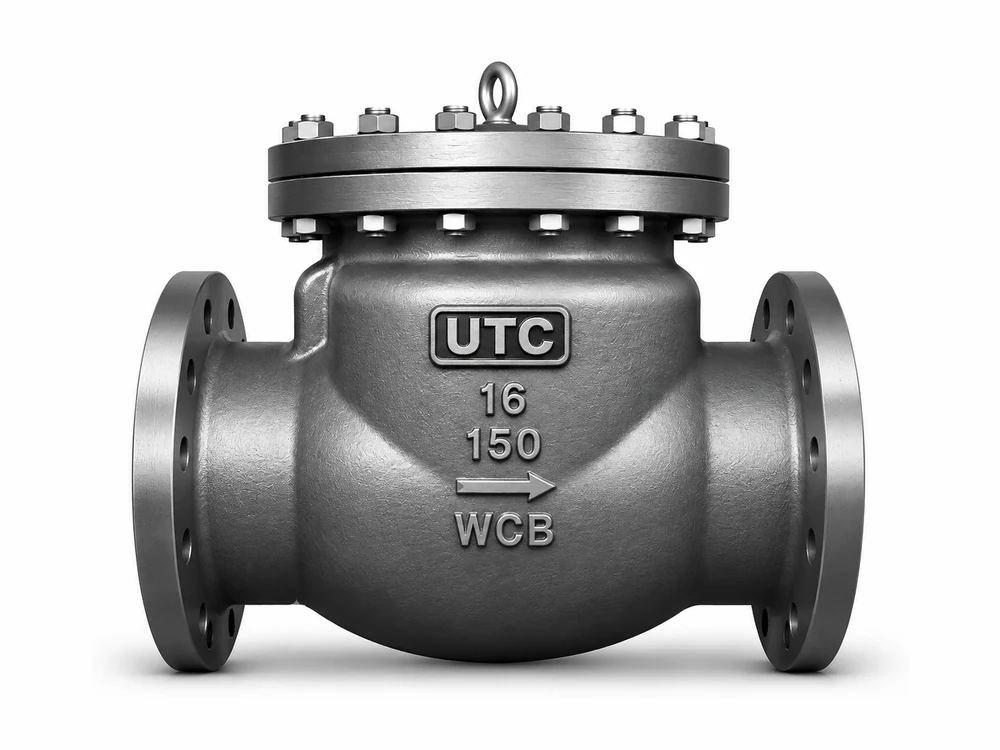
Product specifications
Cast steel swing check valve
| Body material | WCB / WC6 / LCB / CF8 / CF8M / CF3 / CF3M etc. |
|---|---|
| Pressure rating | Class 150 to 2500 |
| Design standard | BS 1868 / ASME B16.34 / API 6D |
| Inspection & testing | API 598 / API 6D / BS EN 12266-1 |
| End connection | Flanged / butt weld / RTJ |
| Size range | 2″ to 20″ |
| Options | Bypass, floor stand |
| Dimensions | Face-to-face ASME B16.10; flanges ASME B16.5; butt-weld ends ASME B16.25 |
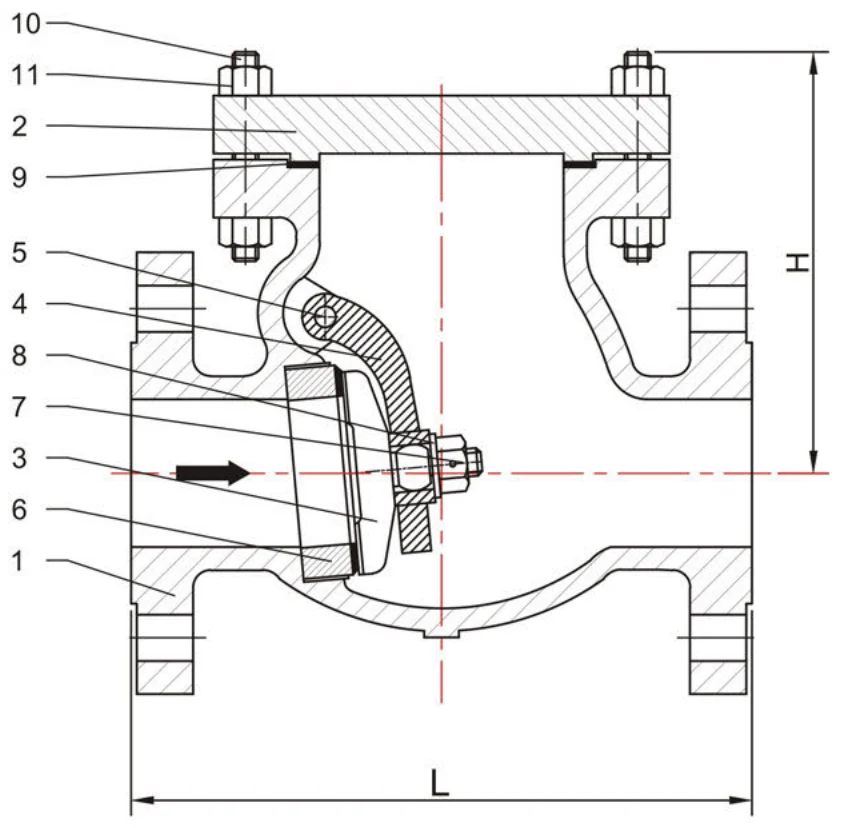
Dimensions & technical details (mm)
| Parameter | Class | 2″ | 3″ | 4″ | 5″ | 6″ | 8″ | 10″ | 12″ | 14″ | 16″ | 18″ | 20″ |
|---|---|---|---|---|---|---|---|---|---|---|---|---|---|
| Face to face (L) | 150# | 203 | 241 | 292 | 356 | 406 | 495 | 622 | 698 | 787 | 914 | 978 | 978 |
| 300# | 267 | 318 | 355 | 400 | 444 | 533 | 622 | 711 | 838 | 864 | 978 | 1016 | |
| 600# | 292 | 355 | 431 | 508 | 558 | 660 | 787 | 838 | 889 | 991 | 1092 | 1194 | |
| 900# | 368 | 381 | 457 | 559 | 610 | 737 | 838 | 965 | 1029 | 1130 | 1219 | 1321 | |
| 1500# | 368 | 470 | 546 | 673 | 705 | 832 | 991 | 1130 | 1257 | 1384 | 1537 | 1664 | |
| Height (H) approx. | 150# | 155 | 200 | 225 | 245 | 260 | 305 | 390 | 410 | 435 | 530 | 570 | 625 |
| 300# | 180 | 225 | 240 | 275 | 310 | 370 | 410 | 440 | 500 | 545 | 605 | 675 | |
| 600# | 190 | 250 | 260 | 310 | 350 | 420 | 490 | 525 | 580 | 630 | 690 | 810 | |
| 900# | 195 | 260 | 275 | 320 | 370 | 435 | 520 | 530 | 580 | 660 | 782 | 935 | |
| 1500# | 220 | 290 | 310 | 350 | 410 | 485 | 530 | 590 | 620 | 790 | 950 | 1150 | |
| Weight (kg) approx. | 150# | 15 | 33 | 45 | 77 | 90 | 118 | 220 | 340 | 470 | 575 | 790 | 920 |
| 300# | 28 | 55 | 72 | 108 | 158 | 232 | 350 | 449 | 645 | 800 | 972 | 1352 | |
| 600# | 33 | 55 | 90 | 120 | 210 | 320 | 550 | 790 | 950 | 1240 | 1814 | 2267 | |
| 900# | 55 | 90 | 135 | 165 | 295 | 525 | 900 | 1075 | 1225 | 1425 | 1900 | 2510 | |
| 1500# | 70 | 115 | 175 | 180 | 370 | 680 | 1050 | 1180 | 1325 | 1530 | 2040 | 2670 |
Material list
| No. | Part | Material (ASTM specification) |
|---|---|---|
| 1 | Body | WCB / WC6 / WC9 / CF8 / CF8M / CF3 / CF3M / LCB |
| 2 | Cover | WCB / WC6 / WC9 / CF8 / CF8M / CF3 / CF3M / LCB |
| 3 | Disc | WCB / WC6 / WC9 / CF8 / CF8M / CF3 / CF3M / LCB |
| 4 | Hinge | WCB / WC6 / WC9 / CF8 / CF8M / CF3 / CF3M / LCB |
| 5 | Hinge pin | SS 410 / SS 304 / SS 304L / SS 316L |
| 6 | Seat ring | F6a / A105 / LF2 / SS 316 / SS 304 / F51 |
| 7 | Disc nut | Carbon Steel / Stainless Steel |
| 8 | Washer | Carbon Steel / Stainless Steel |
| 9 | Gasket | Spiral Wound SS 316 + Graphoil |
| 10 | Cover stud | B7 / B7M / B8M / B8 / L7 |
| 11 | Cover nut | 2H / 8 / 8M / 7 |
How it works
Forward flow lifts or swings the closure element (disc, plate, piston or ball) off its seat. When forward flow drops, the element returns to the seat under gravity, spring force or reverse pressure, preventing backflow. The minimum pressure needed to open the valve is known as the cracking pressure.
Types and configurations
- Swing check – a hinged disc swings open with flow
- Lift / piston check – the disc rises vertically off the seat; common on small-bore lines
- Dual-plate (wafer) check – two spring-loaded half plates; compact and lightweight
- Tilting disc check – reduced slam characteristics
- Ball check and nozzle (axial) check valves for specific duties
Construction and design features
- Automatic operation with no external power
- Bolted cover for internal access on swing designs
- Spring assistance on dual-plate and nozzle types to reduce slam
- Selection of disc and seat materials to suit fluid
- Wafer, lug, flanged and welded body styles
Materials of construction
- Cast carbon steel (e.g. ASTM A216 WCB)
- Cast stainless steel (e.g. ASTM A351 CF8M)
- Forged steel for small sizes (e.g. ASTM A105)
- Ductile iron or bronze for water services, on request
- Availability of each grade is subject to confirmation by UTC VALVES for every enquiry.
Material grades listed are those commonly specified in industry for this valve type. Availability of each grade is subject to confirmation by UTC VALVES for every enquiry.
End connections
- Flanged RF or RTJ
- Wafer and lug styles (dual-plate)
- Butt-weld
- Socket-weld and threaded (small sizes)
Pressure classes and standards
Pressure classes offered by UTC VALVES: listed for each model in the product specifications below.
Standards commonly referenced for this valve type include API 594 (check valves: flanged, lug, wafer and butt-welding), API 6D, BS 1868, ASME B16.34 and API 598. These are industry references; they do not indicate that UTC VALVES or its products hold certification. Compliance documents are provided per order where available.
Industrial applications
- Pump discharge protection
- Compressor outlet lines
- Boiler feedwater systems
- Cooling water circuits
- Pipeline backflow prevention
Industries served
- Water & wastewater
- Oil & gas
- Power generation
- Desalination
- Chemical processing
Information to include in your enquiry
A complete enquiry helps us respond with an accurate offer for check valves:
- Valve type and configuration
- Nominal size (NPS / DN)
- Pressure class or rating
- Body, trim and seat materials
- End connection and facing
- Operator: lever, handwheel, gear or actuator
- Service fluid, design pressure and temperature
- Applicable standard or project specification
- Quantity and required delivery date
- Inspection, testing and documentation requirements (e.g. material test certificates, third-party inspection)
Check Valves: frequently asked questions
Can a swing check valve be installed vertically?
Only in vertical lines with upward flow, and only where the design permits it. Downward-flow installations need a spring-assisted design. Confirm orientation with the valve datasheet.
What is check valve slam?
Slam is the sudden closure of the disc when flow reverses, which can create a pressure surge (water hammer). Fast-closing designs such as dual-plate or nozzle check valves help reduce it.
Where should a check valve be placed relative to a pump?
Typically on the pump discharge, upstream of the isolation valve, so the check valve can be isolated for maintenance. Follow the project piping design.
Related valve categories
Request a quote for check valves
Send your specification, datasheet or bill of materials. Our team reviews every enquiry and responds with availability and a quotation.