Ball Valves Manufacturer – Industrial Ball Valves
Ball valves are quarter-turn valves that use a bored ball to control flow.
About our ball valves
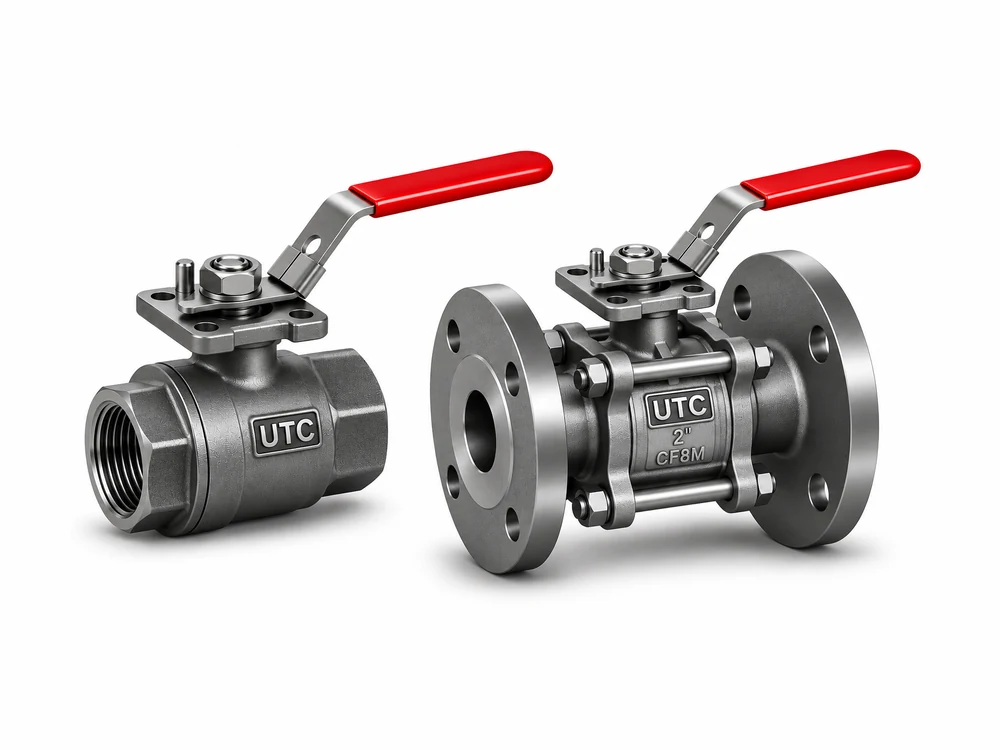
Ball valves are quarter-turn valves that use a bored ball to control flow. Turning the stem 90° aligns the bore with the pipeline to open, or turns it across the flow to close. They offer fast operation, compact construction and tight shut-off. UTC VALVES manufactures and supplies ball valves for isolation duties in oil and gas, process, utility and water services.
Product specifications
Cast steel ball valve
| Body material | WCB / WC6 / WC9 / LCB / CF8 / CF8M / CF3 / CF3M |
|---|---|
| Pressure rating | Class 150 to 1500 |
| Design standard | BS 5351 / ASME B16.34 / API 607 (fire-safe design) |
| Inspection & testing | API 598 / BS EN 12266-1 |
| End connection | Flanged / screwed / socket weld |
| Size range | ½” to 10″ |
| Seats | PTFE / graphite-filled PTFE |
| Options | Single, two or three piece; fire-safe or non-fire-safe |
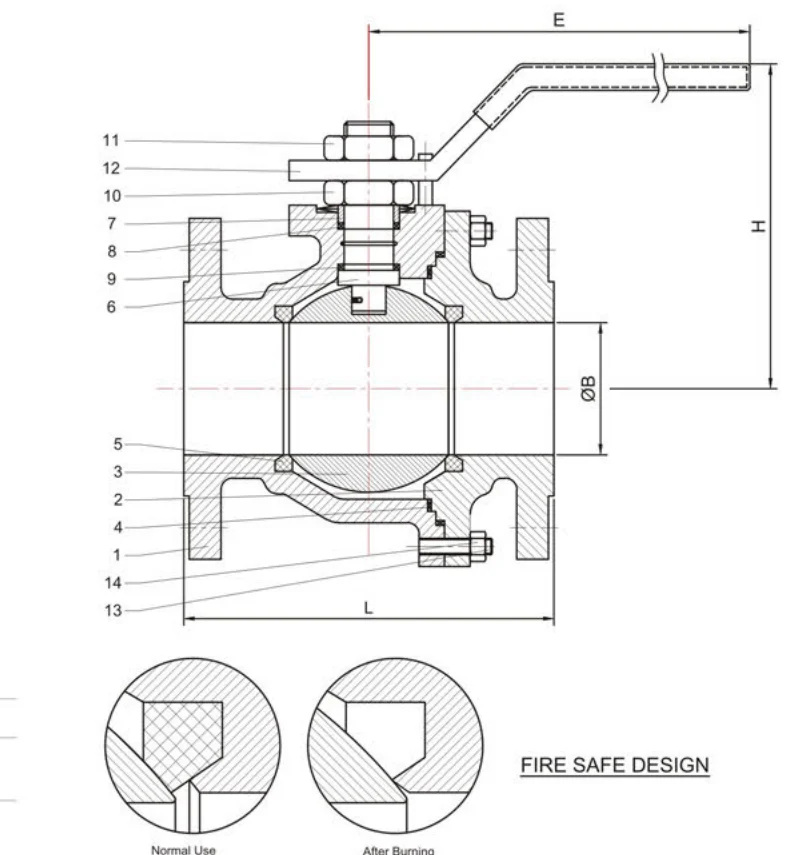
Dimensions & technical details (mm)
| Parameter | Class | ½” | ¾” | 1″ | 1¼” | 1½” | 2″ | 3″ | 4″ | 6″ | 8″ |
|---|---|---|---|---|---|---|---|---|---|---|---|
| Face to face (L) | 150# | 108 | 117 | 127 | 140 | 165 | 178 | 203 | 229 | 267 | 292 |
| 300# | 140 | 152 | 165 | 178 | 190 | 316 | 282 | 305 | 403 | 502 | |
| 600# | 165 | 190 | 216 | 229 | 241 | 292 | 356 | 432 | 559 | 660 | |
| Port dia. (ØB) | 150# | 12.5 | 17 | 24 | 37 | 49 | 64 | 75 | 98 | 148 | 198 |
| 300# | 12.5 | 17 | 24 | 37 | 49 | 64 | 75 | 98 | 148 | 198 | |
| 600# | 12.5 | 17 | 24 | 37 | 49 | 64 | 75 | 98 | 148 | 198 | |
| Height (H) approx. | 150# | 65 | 70 | 80 | 95 | 110 | 135 | 145 | 170 | 235 | 275 |
| 300# | 70 | 85 | 90 | 105 | 120 | 145 | 160 | 195 | 250 | 290 | |
| 600# | 76 | 108 | 111 | 130 | 137 | 170 | 184 | 228 | 250 | 290 | |
| Length (E) | 150# | 150 | 155 | 160 | 180 | 200 | 225 | 325 | 350 | 500 | 600 |
| 300# | 155 | 160 | 180 | 200 | 225 | 325 | 350 | 500 | 600 | 700 | |
| 600# | – | – | – | – | – | – | – | – | – | – | |
| Weight (kg) approx. | 150# | 3 | 4 | 5 | 8 | 12 | 21 | 26 | 43 | 80 | 155 |
| 300# | 3 | 5 | 7 | 13 | 15 | 28 | 32 | 55 | 105 | 170 | |
| 600# | – | – | – | – | – | – | – | – | – | – |
Weights and dimensions are for reference only.
Material list
| No. | Part | Material (ASTM specification) |
|---|---|---|
| 1 | Body | WCB / WC6 / WC9 / CF8 / CF8M / CF3 / CF3M / LCB |
| 2 | Side piece | WCB / WC6 / WC9 / CF8 / CF8M / CF3 / CF3M / LCB |
| 3 | Ball | CF8 / CF8M / F304 / F316 / F6a |
| 4 | Body seal | PTFE / Graphoil / Spiral Wound SS 316 with Graphoil |
| 5 | Seats | PTFE / Graphite Filled PTFE |
| 6 | Stem | SS 410 / SS 304 / SS 316L |
| 7 | Gland bush | SS 304 / SS 316L |
| 8 | Gland packing | PTFE Graphoil |
| 9 | Gland nut | Graphoil / Graphite Filled PTFE |
| 10 | Stem nut | Stainless Steel |
| 11 | Stem nut | Stainless Steel |
| 12 | Lever | Carbon Steel with PVC |
| 13 | Stud | B7 / B8 / B8M / L7 |
| 14 | Nut | 2H / 8 / 8M / 7 |
We also offer Inconel 625, Super Duplex Gr. 5A & 6A and Nickel Al. Bronze MOC.
How it works
A ball with a through-bore sits between two seats. When the bore is in line with the pipe, flow passes with little resistance. A quarter turn rotates the solid side of the ball across the flow path, and the seats seal against the ball surface.
Types and configurations
- Floating ball – the ball is pushed by line pressure against the downstream seat; common in smaller sizes
- Trunnion-mounted ball – the ball is anchored and the seats move; used for larger sizes and higher pressures
- Full bore and reduced bore
- Two-piece, three-piece, side-entry, top-entry and fully welded bodies
- Double block and bleed (DBB) configurations
- V-port ball valves for control duty
Construction and design features
- Quarter-turn operation by lever, gear or actuator
- Soft seats (e.g. PTFE, reinforced PTFE, PEEK) or metal seats, depending on service
- Anti-static and blow-out-proof stem features (design-dependent)
- Fire-safe designs type-tested to standards such as API 607 / ISO 10497 – certification must be confirmed per product
- ISO 5211 mounting pads for actuation, where provided
Materials of construction
- Forged or cast carbon steel (e.g. ASTM A105, A216 WCB)
- Stainless steel (e.g. ASTM A182 F316, A351 CF8M)
- Low-temperature carbon steel (e.g. ASTM A350 LF2)
- Duplex stainless steel for corrosive service, on request
- Seat and seal materials selected for fluid and temperature
Material grades listed are those commonly specified in industry for this valve type. Availability of each grade is subject to confirmation by UTC VALVES for every enquiry.
End connections
- Flanged RF or RTJ
- Butt-weld ends
- Threaded or socket-weld ends on small sizes
- Pipeline transition pups, where specified
Pressure classes and standards
Pressure classes offered by UTC VALVES: listed for each model in the product specifications below.
Standards commonly referenced for this valve type include API 6D (pipeline valves), API 608 (metal ball valves), ISO 17292, ASME B16.34 and API 598. These are industry references; they do not indicate that UTC VALVES or its products hold certification. Compliance documents are provided per order where available.
Industrial applications
- Pipeline isolation and emergency shut-off
- Process plant on/off service
- Gas distribution
- Chemical injection and utility lines
- Actuated isolation in automated systems
Industries served
- Oil & gas
- Petrochemicals
- Water treatment
- Chemical processing
- Industrial utilities
Information to include in your enquiry
A complete enquiry helps us respond with an accurate offer for ball valves:
- Valve type and configuration
- Nominal size (NPS / DN)
- Pressure class or rating
- Body, trim and seat materials
- End connection and facing
- Operator: lever, handwheel, gear or actuator
- Service fluid, design pressure and temperature
- Applicable standard or project specification
- Quantity and required delivery date
- Inspection, testing and documentation requirements (e.g. material test certificates, third-party inspection)
Ball Valves: frequently asked questions
What is the difference between a floating and a trunnion ball valve?
In a floating design, line pressure moves the ball slightly onto the downstream seat. In a trunnion design, the ball is held by upper and lower trunnions and spring-loaded seats seal against it, which keeps operating torque lower in large sizes and high pressure classes.
Are ball valves suitable for throttling?
Standard ball valves are designed for on/off service; partial opening can damage soft seats. V-port or segmented ball valves are designed for control.
What does fire-safe mean?
It means the valve design has been type-tested to a fire test standard such as API 607 or ISO 10497. Ask for the applicable test certificate for the specific model being quoted.
Related valve categories
Request a quote for ball valves
Send your specification, datasheet or bill of materials. Our team reviews every enquiry and responds with availability and a quotation.