Pressure Reducing Valves Manufacturer – Pilot-Operated PRVs
Pressure reducing valves bring a high, fluctuating inlet pressure down to a steady, lower outlet pressure for water, air, steam and gas lines.
About our pressure reducing valves
Pressure reducing valves (PRVs) bring a high, fluctuating inlet pressure down to a steady, lower outlet pressure. UTC VALVES supplies pilot-operated, piston-sensing PRVs for steam, water, air and gas services in process plants, boiler houses and utilities.
A small pilot senses the downstream pressure and drives the main piston, so the valve holds the set pressure accurately across a wide range of flows. Internals are stainless steel for long service life.

Product specifications
Pilot-operated piston-sensing PRV
| Design | Pilot-operated, piston-sensing pressure reducing valve |
|---|---|
| Size | 3″ (80 NB); other sizes on request |
| Pressure rating | ASME Class 150 |
| End connection | Flanged, ASME B16.5 RF |
| Inlet pressure | 4 – 10 bar |
| Outlet (set) pressure | 2.8 – 4.1 bar, adjustable; other ranges on request |
| Media | Water, air, steam and gas |
| Temperature | Up to 250 °C |
| Seat leakage | Class IV |
| Face to face (3″) | 320 mm |
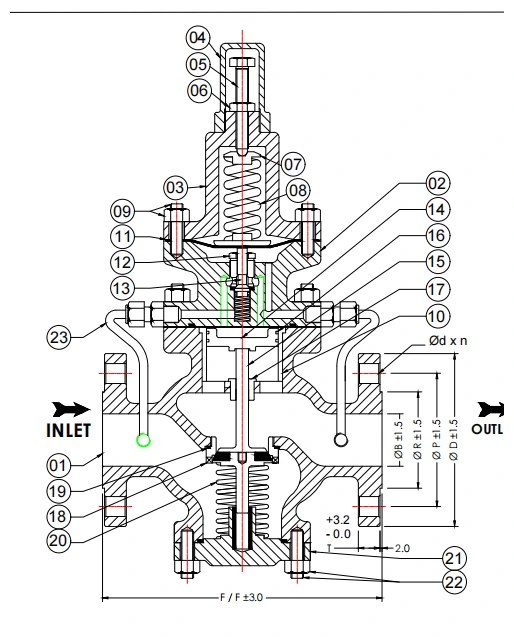
Dimensions & technical details (mm)
| Size (in) | Size (mm) | F/F | ØD | ØP | ØR | T | Ød | n |
|---|---|---|---|---|---|---|---|---|
| 3″ | 80 | 320.0 | 190.0 | 152.4 | 127.0 | 22.4 | 19.1 | 4 |
F/F ±3.0; flange diameters ±1.5. Flange drilling to ASME B16.5 Class 150. Other sizes on request.
Materials of construction
| Part | Material |
|---|---|
| Body, bonnet, pilot body, bottom cover | ASTM A216 Gr. WCB |
| Main piston, main plug, plug guide, main seat | SS 304 |
| Pilot diaphragm, pilot seat, pilot plug | SS 304 |
| Springs, adjusting screw, cap, lock nut, sleeve | SS 304 |
| Piston ring | Nitrile |
| Seat gasket | PTFE |
| Studs / nuts | ASTM A193 Gr. B7 / A194 Gr. 2H |
| Sensing tubing & fittings | SS 316 |
Typical applications
- Steam distribution to process equipment, heat exchangers and jacketed vessels
- Boiler house and utility steam headers
- Water supply and building services where mains pressure must be reduced
- Compressed air and gas lines feeding lower-pressure equipment
Information to include in your enquiry
- Medium (steam, water, air or gas) and temperature
- Inlet pressure range and required outlet pressure
- Maximum and minimum flow rate
- Line size, pressure class and end connection
- Quantity, delivery date and documentation required
Pressure reducing valves: frequently asked questions
What does a pressure reducing valve do?
It reduces a higher, often fluctuating inlet pressure to a steady, lower outlet pressure, protecting downstream equipment and keeping process conditions stable.
How does a pilot-operated PRV work?
A small pilot valve senses the downstream pressure and controls the main piston. This gives accurate pressure control across a wide range of flows.
Can the outlet pressure be adjusted?
Yes. The set pressure is adjusted with the adjusting screw on the pilot, within the range of the fitted spring. Other spring ranges are available on request.
How should a PRV be installed?
Fit a strainer upstream, isolation valves and a bypass around the PRV, pressure gauges on both sides, and a safety valve downstream to protect the low-pressure side.
Related valve categories
Request a quote for pressure reducing valves
Send your inlet and outlet pressure, flow and line size. Our team reviews every enquiry and responds with availability and a quotation.