Most valve and pump failures begin with something small: weld spatter, scale, a stray gasket fragment, a piece of rust. A strainer is a cheap piece of equipment that stops those particles before they reach the parts that cannot tolerate them. The Y-type strainer is the most common design in industrial piping because it is compact, simple and works in many orientations.
This article explains how a Y-type strainer works, where it belongs in a system and how to select and maintain one.
What a Y-type strainer is
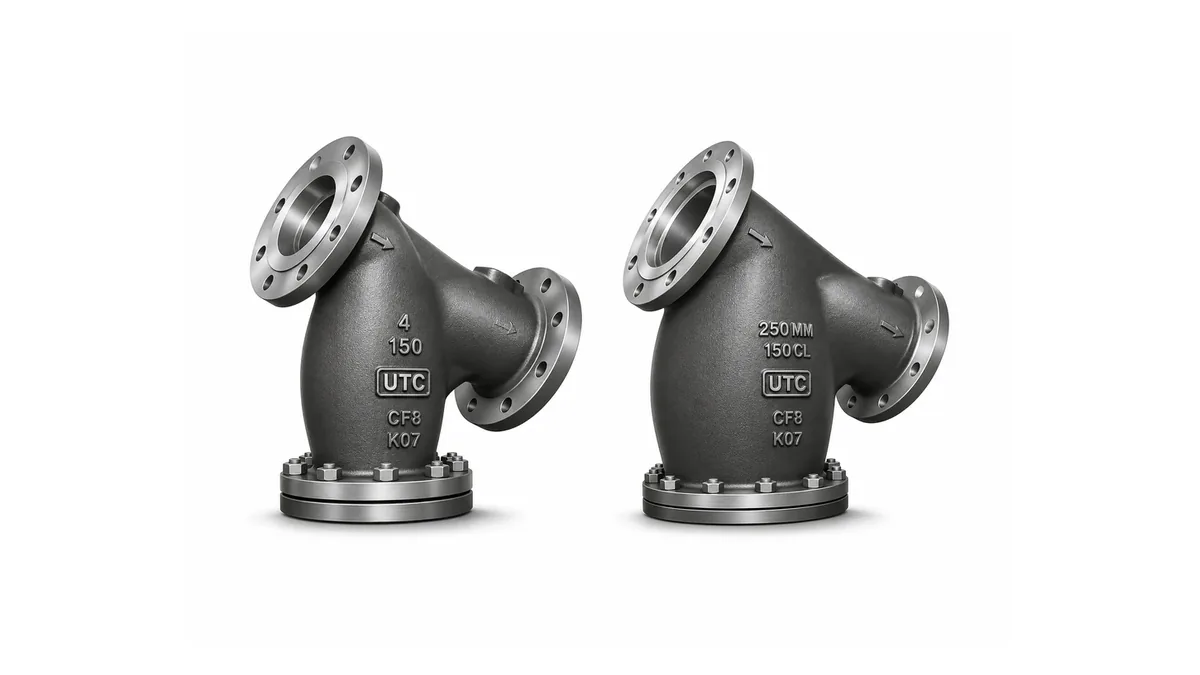
A Y-type strainer has a body shaped like a Y, with the inlet and outlet in line and a branch set at an angle. Inside the branch sits a cylindrical screen, made of perforated plate or wire mesh. The branch ends in a cap that can be removed for cleaning, and often has a threaded connection for a blow-off valve.
A strainer is a protective device, not a fine filter. It removes particles above the mesh or perforation size and leaves the fluid otherwise unchanged. For very fine filtration, cartridge or bag filters are used instead.
How it works
Fluid enters the body and is forced through the screen from the inside to the outside. Particles larger than the screen openings stay inside the screen, and clean fluid exits through the outlet. Debris collects in the angled branch below the screen, where it has little effect on flow until the screen becomes partly blocked. As the screen fills, the pressure difference across the strainer increases. When it reaches a limit set by the operator, the strainer must be cleaned.
Where Y-type strainers are used
- Upstream of centrifugal and reciprocating pumps
- Ahead of control valves, whose trims are easily damaged
- Before flow meters and orifice plates
- Ahead of steam traps and steam pressure-reducing stations
- At heat exchanger inlets
- On boiler feed and condensate lines
- On compressor suction and cooling water lines
They are used across oil and gas, power, chemical, water treatment and general industry. Our strainers page lists the configurations we supply.
Y-type compared with other strainers
| Type | Strengths | Limits |
|---|---|---|
| Y-type | Compact, low cost, works horizontally or vertically | Smaller dirt capacity, so cleaning is more frequent in dirty lines |
| Basket (T-type) | Large dirt-holding capacity | Larger body and more space; usually horizontal |
| Duplex basket | Allows cleaning without stopping flow | Higher cost, more complex |
| Temporary (cone) | Protects equipment during start-up | Removed after commissioning |
Choosing mesh and perforation size
The screen opening depends on what must be protected. A pump manufacturer or a control valve supplier often states the largest particle the equipment can tolerate, and that sets the mesh. Finer meshes protect better but clog faster. A common approach is to use a coarser perforated screen for general protection and a finer mesh liner where the equipment demands it, since finer mesh is also less strong and needs support.
Pay attention to the open area. A strainer screen should offer a free flow area that is a multiple of the pipe area, so that a partly blocked screen does not cause a high pressure drop straight away. Ask the supplier for the open-area ratio and for the clean pressure drop at the design flow.
Materials, sizes and ratings
Bodies are available in cast carbon steel (ASTM A216 WCB), cast stainless steel (ASTM A351 CF8M) and other grades, depending on the fluid. Screens are normally stainless steel. End connections are normally flanged in the larger sizes and threaded or socket-weld in small sizes. Pressure class follows the piping specification and the ratings in ASME B16.34 for steel bodies. Confirm the grade and class availability for each enquiry.
Installation guidance
- Install in the direction of the flow arrow cast on the body.
- On horizontal liquid lines, install with the screen cap pointing down so debris collects in the cap.
- On steam and gas lines, orient the screen on its side to avoid condensate collecting in the cap, as guided by the manufacturer.
- On vertical lines, flow normally runs downward so that debris falls into the cap.
- Leave enough clearance to remove the cap and withdraw the screen.
- Fit a blow-off valve in the cap where regular cleaning without disassembly is useful.
Place the strainer upstream of the equipment it protects and downstream of any isolating valve, so that you can isolate it for cleaning.
Cleaning and maintenance
Strainers need regular cleaning. Isolate and depressurise the line, drain the strainer, remove the cap and the screen, clean and inspect the screen for damage, then refit with a sound gasket. If a blow-off valve is fitted, open it slowly to flush debris out before it builds up. During commissioning of new lines, expect the screen to catch a lot of construction debris, so inspect it frequently in the first days. A differential pressure gauge across the strainer tells you when cleaning is due and avoids relying on a calendar alone.
Common mistakes
- Installing the strainer upside down or against the flow arrow
- Choosing a mesh finer than needed, which blocks in days
- Forgetting to leave room to withdraw the screen
- Leaving a strainer out of the maintenance plan
- Using a damaged screen, which allows debris through
See our article on common valve problems for the damage that debris can cause to valves.
Sizing a strainer for the line
A strainer is normally the same size as the line, but the size should still be checked against the flow rate. A strainer that is too small for the flow causes high velocity through the screen, high pressure drop and quicker blockage. Compare the clean pressure drop at design flow with the allowable pressure drop for the system, and make sure the system can accept the additional resistance when the screen is partly blocked. In pump suction lines, the strainer’s pressure drop reduces the net positive suction head available, so it is worth checking against the pump’s requirement as well.
Strainer or temporary start-up screen?
New piping systems carry a lot of construction debris, such as weld spatter, scale and sand. Many projects fit temporary start-up strainers or fine-mesh liners during commissioning, and remove them once the system is clean. This protects pumps and instruments during the period when debris load is highest, while permanent strainers can then be sized for normal operation. If your project uses temporary screens, remember to include their removal in the commissioning plan; a forgotten screen can restrict flow for years.
Selecting a strainer
State the line size, design pressure and temperature, fluid, flow rate, required mesh, end connections, body and screen material, and whether a blow-off connection is needed. Send these through Request a Quote.
Frequently asked questions
Is a strainer the same as a filter?
No. A strainer removes larger particles to protect equipment, while a filter removes much finer particles from the fluid.
How often should a Y-strainer be cleaned?
It depends on how dirty the line is. Use differential pressure across the strainer to decide, and clean frequently during commissioning.
Can a Y-strainer be installed vertically?
Yes, usually with downward flow and the cap at the bottom, as guided by the manufacturer.
What mesh size should I choose?
Use the largest particle size that the protected equipment can tolerate, as stated by its manufacturer.
References and further reading
Standards and codes are published by their issuing bodies. Always use the current edition named in your project specification.