A valve’s pressure class is one of the first items on a data sheet, and one of the most misunderstood. Class 150 does not mean 150 psi, and Class 600 does not mean 600 psi. The class is a rating designation, and the pressure a valve can actually hold depends on the temperature and the material.
This article explains what pressure class means under ASME B16.34, how the ratings change with temperature, and how to choose a class for a line.
What pressure class means
Under ASME B16.34, steel valves are assigned a class such as 150, 300, 600, 900, 1500 or 2500. For each class and each material group, the standard gives a table of maximum allowable working pressure at each temperature. The class is therefore a family of ratings, not a single pressure. The same class number is used for flanges under ASME B16.5, so a Class 300 valve mates with a Class 300 flange, which is what makes the system interchangeable.
Material also matters. Carbon steel such as ASTM A216 WCB and A105 sits in material group 1.1. Stainless steels and alloy steels sit in other groups with different rating tables, so the same class has slightly different pressure ratings in different materials.
Ratings at ambient temperature
The table shows approximate maximum pressures for group 1.1 carbon steel at ambient temperature (about -29 to 38 degrees Celsius). These figures are shown for orientation; the full tables in ASME B16.34 are the reference.
| Class | Maximum pressure, psig | Maximum pressure, bar (approx.) |
|---|---|---|
| 150 | 285 | 19.6 |
| 300 | 740 | 51 |
| 600 | 1,480 | 102 |
| 900 | 2,220 | 153 |
How temperature changes the rating
As temperature increases, the allowable stress of the material falls, and so does the rating. A Class 150 carbon steel valve is rated for 285 psig at ambient temperature but only about 170 psig at 500 degrees Fahrenheit (about 260 degrees Celsius). In bar terms, Class 150 falls from about 19.6 bar to roughly 15.9 bar at 250 degrees Celsius, and Class 300 falls from about 51 bar to roughly 41 bar at the same temperature.
This is why you must always read the class together with the design temperature. A line that operates at 300 psig at ambient temperature might be fine in Class 300, while the same pressure at high temperature may need a higher class. Use the exact table for the material group rather than interpolating from memory.
What changes as the class goes up
- Wall thickness of the body increases to carry the pressure.
- Flange thickness, diameter and bolt count increase, so valves and flanges are larger and heavier.
- Face-to-face dimensions are different for each class, as set out in ASME B16.10.
- Facing type often changes: raised face is common in lower classes, and ring-type joint flanges are often used at higher classes.
- Cost and lead time rise with class.
Do not mix classes in a single flanged joint. A Class 600 flange will not bolt up to a Class 300 flange.
Typical uses of each class
| Class | Typical uses (illustrative) |
|---|---|
| 150 | Utilities, water, low-pressure steam, general services |
| 300 | Process lines, hydrocarbon service, moderate pressure steam |
| 600 | Higher pressure process lines, steam and feedwater, pipelines |
| 900 | High-pressure steam, hydrocarbon service, refinery units |
Those are general examples, not rules. The design pressure and temperature, the fluid and the piping specification decide the class. For classes of 600 and above in steam service, pressure seal valves are commonly considered.
Pressure class and testing
Valve testing relates to the class rating. Hydrostatic shell tests are normally carried out at a pressure of 1.5 times the 38 degrees Celsius rating, and seat tests at 1.1 times. The exact requirements are given in ASME B16.34 and in the testing standard, such as API 598. Always check the values in the standard cited by your project. Our article on valve inspection and testing describes the tests in more detail.
Class 800 and other designations
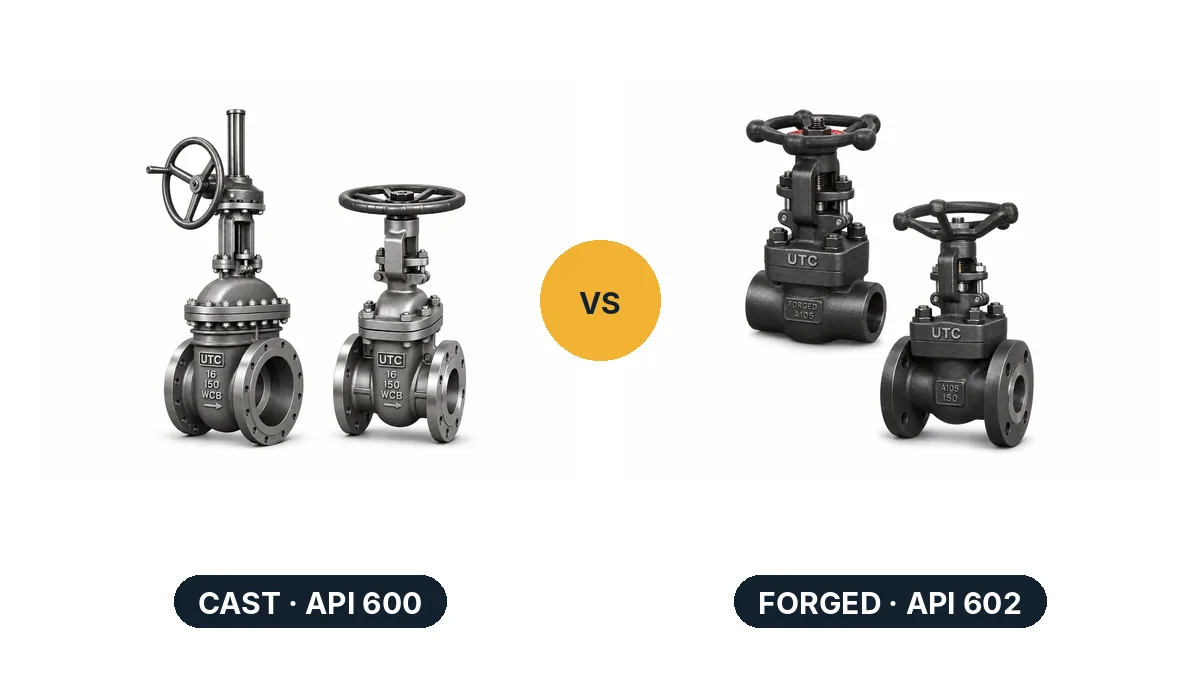
Small forged valves built to API 602 include a Class 800 designation, which is used for threaded and socket-weld ends in small sizes. It is a convention specific to forged small-bore valves and is not part of the B16.34 class list in the same way as 150, 300, 600 and 900. See forged steel valves and our guide to API 600 and API 602.
Class versus PN
Many international projects use PN ratings such as PN 16 or PN 40, which come from European and ISO flange standards. PN and Class are different systems, with different bolt patterns and rating methods, so one cannot be substituted for the other without engineering review. If a project uses PN-rated piping, state this clearly on the data sheet.
Two worked examples
Example 1. A line has a design pressure of 16 bar at 250 degrees Celsius, in carbon steel. Class 150 offers only about 15.9 bar at that temperature, which is slightly below the design pressure. Class 300, rated at roughly 41 bar at the same temperature, is the right choice.
Example 2. A line has a design pressure of 200 psig at 500 degrees Fahrenheit. Class 150 carbon steel is rated at about 170 psig at that temperature, which is not enough, so Class 300 is needed. Both examples are illustrative; read the full table for your material group and edition.
Common errors when specifying a class
- Using ambient temperature ratings for hot services
- Choosing the class from operating pressure instead of design pressure
- Forgetting upset conditions, such as steam-out or relief valve set pressure
- Mixing PN and class ratings in one data sheet
- Assuming that all materials have the same rating in the same class
- Ignoring that the flange rating can differ from the valve rating at a given temperature
A short review of these points by the piping engineer before the enquiry is issued can prevent a costly reorder.
How to choose a class
- Establish design pressure and design temperature, including upset conditions.
- Identify the valve material and its ASME B16.34 material group.
- Read the rating table and choose the lowest class whose rating at design temperature exceeds the design pressure.
- Check that the class matches the piping specification and the mating flange.
- Confirm testing, end connections and any extra requirements.
Send your selected class and conditions through Request a Quote, or review our gate valves for the available configurations.
Frequently asked questions
Does Class 150 mean 150 psi?
No. Class 150 is a rating designation. A carbon steel valve is rated for about 285 psig at ambient temperature, falling with temperature.
Can I use a Class 300 valve with a Class 150 flange?
No. Flange and valve classes must match for the bolt pattern and dimensions to fit.
Why does the rating fall at higher temperature?
The allowable stress of the material decreases as temperature rises, so the permitted pressure falls.
Is PN 40 the same as Class 300?
No. They are different systems and are not directly interchangeable.
References and further reading
Standards and codes are published by their issuing bodies. Always use the current edition named in your project specification.