Choosing between carbon steel and stainless steel for a valve is rarely a question of which is better. It is a question of which suits the fluid, the temperature, the expected life and the budget. Carbon steel is the workhorse of oil, gas, steam and water systems. Stainless steel is chosen when corrosion or product purity would otherwise cause trouble.
This article compares the two families, explains the common grades and offers a practical way to choose between them.
Carbon steel valve materials
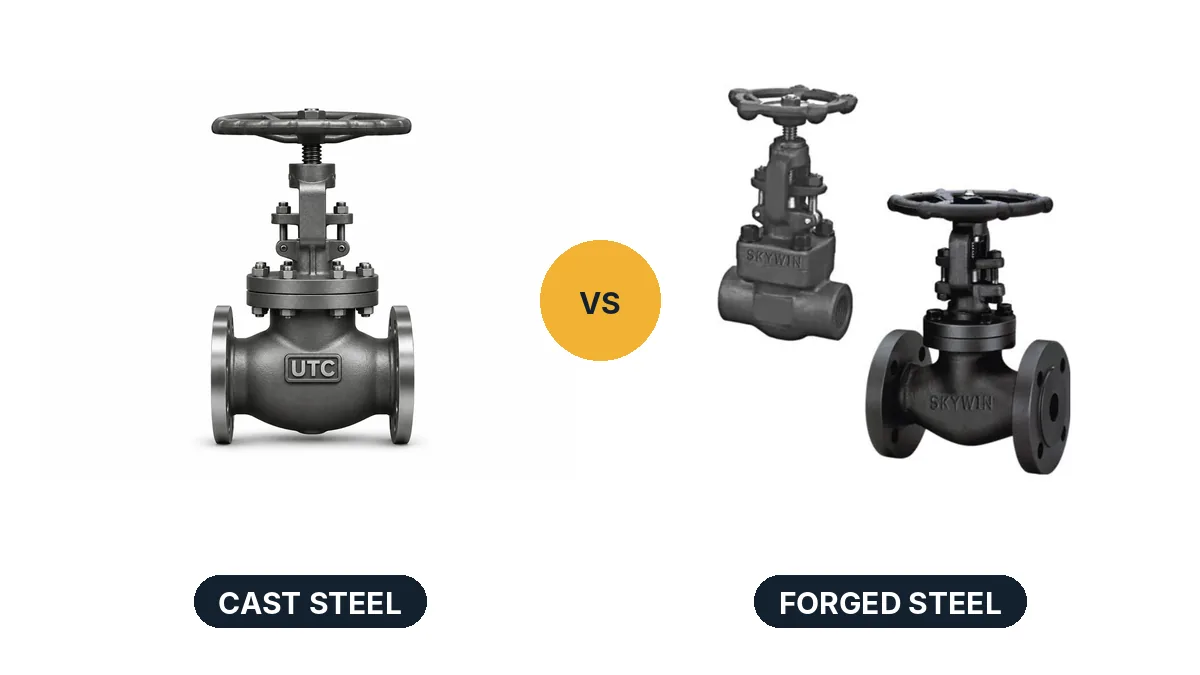
Carbon steel is strong, widely available and economical. For cast bodies the most common grade is ASTM A216 WCB. Forged bodies commonly use ASTM A105. Both belong to material group 1.1 in ASME B16.34, which gives them well-defined pressure–temperature ratings. For low-temperature service, grades such as ASTM A352 LCB and LCC (cast) and A350 LF2 (forged) provide the necessary toughness.
The weakness of carbon steel is corrosion. In wet environments, seawater, acidic conditions and services with carbon dioxide or hydrogen sulphide, it can corrode quickly unless it is protected, inhibited or lined. In long-term high-temperature service, carbon steel also has temperature limits, and alloy steels are used above them.
Stainless steel valve materials
Stainless steels contain chromium, which forms a thin protective oxide layer on the surface. The most common cast grades are ASTM A351 CF8 (similar to type 304) and CF8M (similar to type 316, with molybdenum added for better resistance to pitting and chlorides). Low-carbon versions such as CF3 and CF3M reduce the risk of sensitisation after welding. Forged equivalents include ASTM A182 F304 and F316.
Stainless steel resists a wide range of corrosive fluids, keeps its toughness at very low temperatures and is easy to keep clean. Its weaknesses are higher cost and sensitivity to certain conditions: chloride stress corrosion cracking can occur in hot chloride-bearing environments, and some acids attack it. Stainless steel is not a universal answer.
Side-by-side comparison
| Parameter | Carbon steel (WCB / A105) | Stainless steel (CF8M / F316) |
|---|---|---|
| Corrosion resistance | Limited in wet or aggressive media | Good; molybdenum improves resistance to chlorides |
| Typical use | Hydrocarbons, steam, water, general process | Corrosive chemicals, seawater, food, pharma, cryogenic |
| Strength | High | Good; varies with grade |
| Low-temperature service | Needs special grades (LCB, LF2) | Austenitic grades keep toughness at very low temperature |
| Cost | Lower | Significantly higher |
| Availability | Very wide | Wide, with some grades less common in large sizes |
| Welding | Straightforward | Needs care to avoid sensitisation and distortion |
Trim materials matter too
The body is only part of the valve. Trim, meaning the stem, seat rings, wedge or ball, and sometimes the bolting, is chosen separately. A carbon steel valve is often fitted with 13 per cent chromium steel trim for general service, with hard-facing such as cobalt-based alloys on seating faces in erosive or high-temperature service. Stainless steel valves use stainless trims, sometimes hard-faced. Seats may be polymer or metal. A mismatch between body and trim can shorten service life, so specify both on the data sheet.
Choosing by service
| Service | Typical material direction |
|---|---|
| Clean water, cooling water | Carbon steel, often with coating or lining where needed |
| Saturated and superheated steam | Carbon steel at moderate temperature, chrome-moly alloys at higher temperature |
| Hydrocarbons, non-sour | Carbon steel |
| Sour service (H2S) | Carbon steel or alloys complying with NACE MR0175 / ISO 15156 |
| Seawater and brackish water | Stainless, duplex or other corrosion-resistant alloys, depending on temperature |
| Dilute acids and aggressive chemicals | Stainless or other alloys, subject to corrosion data |
| Cryogenic | Austenitic stainless, subject to design standards |
This table gives directions only. The final selection should be confirmed by the process or materials engineer using corrosion data for the actual fluid, concentration and temperature.
Corrosion allowance and life-cycle cost
Carbon steel valve bodies are made with a corrosion allowance built into the wall thickness, which provides some margin for slow corrosion. In services where corrosion is expected to be modest, carbon steel with periodic inspection can be the most economical choice over the plant life. Where corrosion would cause leaks, product contamination or frequent replacement, the higher price of stainless steel is often repaid. Compare the cost of the valve with the cost of downtime, rework and replacement rather than comparing purchase prices alone.
Verification and documentation
Grade mix-ups are costly. Ask for material test certificates covering chemistry and mechanical properties, and consider positive material identification (PMI) on received valves for critical alloy services. Markings on the body should show the material grade, class and size, in line with the applicable standard. See our quality and standards page and the article on valve inspection and testing.
Practical tips
- Do not specify stainless steel simply “to be safe”; unnecessary cost and the risk of chloride cracking both count against it.
- Do not assume a carbon steel valve will survive a corrosive fluid because it is “only a test line”.
- Check galvanic effects where dissimilar metals meet in wet environments.
- State bolting grades, because they matter for temperature and corrosion.
- Confirm grade availability for each enquiry rather than assuming it.
Temperature considerations
Material choice follows temperature as much as it follows corrosion. At low temperatures, ordinary carbon steel becomes brittle, so grades with impact-tested toughness such as LCB or LF2 are specified. At high temperatures, strength and creep behaviour matter, and chrome-moly steels take over from plain carbon steel. Austenitic stainless steels remain tough at very low temperatures and retain strength at high temperatures, but they have their own limits, and in hot chloride service the cracking risk can outweigh the corrosion benefit. State the minimum and maximum design metal temperatures on the data sheet so that the supplier can propose a suitable grade.
Questions to ask your process engineer
- What are the fluid composition, including chloride, CO2 and H2S content?
- What are the minimum and maximum design temperatures?
- Is the line intermittent, with wet and dry cycles?
- What is the expected design life and corrosion allowance?
- Do owner specifications restrict certain grades?
Answers to these questions usually settle the choice quickly and reduce the chance of a costly mismatch.
Next step
Browse our gate valves, ball valves and forged steel valves pages, then send the material and service requirements through Request a Quote.
Frequently asked questions
What is the difference between WCB and CF8M?
WCB is a cast carbon steel grade, and CF8M is a cast stainless steel grade with molybdenum, which gives better corrosion resistance.
Is stainless steel always better?
No. It resists many corrosive fluids but costs more, and it can crack in hot chloride environments.
What material group is WCB in ASME B16.34?
Carbon steels such as WCB and A105 are in material group 1.1.
Do I need PMI testing?
It is often specified for alloy and stainless services to confirm the grade; check your project specification.
References and further reading
Standards and codes are published by their issuing bodies. Always use the current edition named in your project specification.