Oil and gas facilities depend on valves at every stage, from the wellhead to the refinery. They control flow, isolate equipment for maintenance, prevent backflow and protect vessels from overpressure. The conditions are demanding: high pressures, flammable fluids, corrosive species such as hydrogen sulphide and carbon dioxide, and a requirement for dependable shut-off.
This article maps the main valve types to the stages of the oil and gas chain, explains the special requirements the industry places on them and lists the standards that usually apply.
Valves across the oil and gas chain
The industry is usually split into upstream (exploration and production), midstream (gathering, transport, storage and processing) and downstream (refining and distribution). The duties differ in each, so the valve types do too.
| Stage | Typical duties | Common valve types |
|---|---|---|
| Upstream | Wellhead and manifold isolation, separation, gathering | Gate, ball, check, safety valves, strainers |
| Midstream | Pipeline isolation, compressor stations, storage tanks | Ball (pipeline), gate, check, globe, safety valves |
| Downstream | Process units, utilities, steam and cooling water | Gate, globe, check, pressure seal, forged steel, strainers |
Gate valves
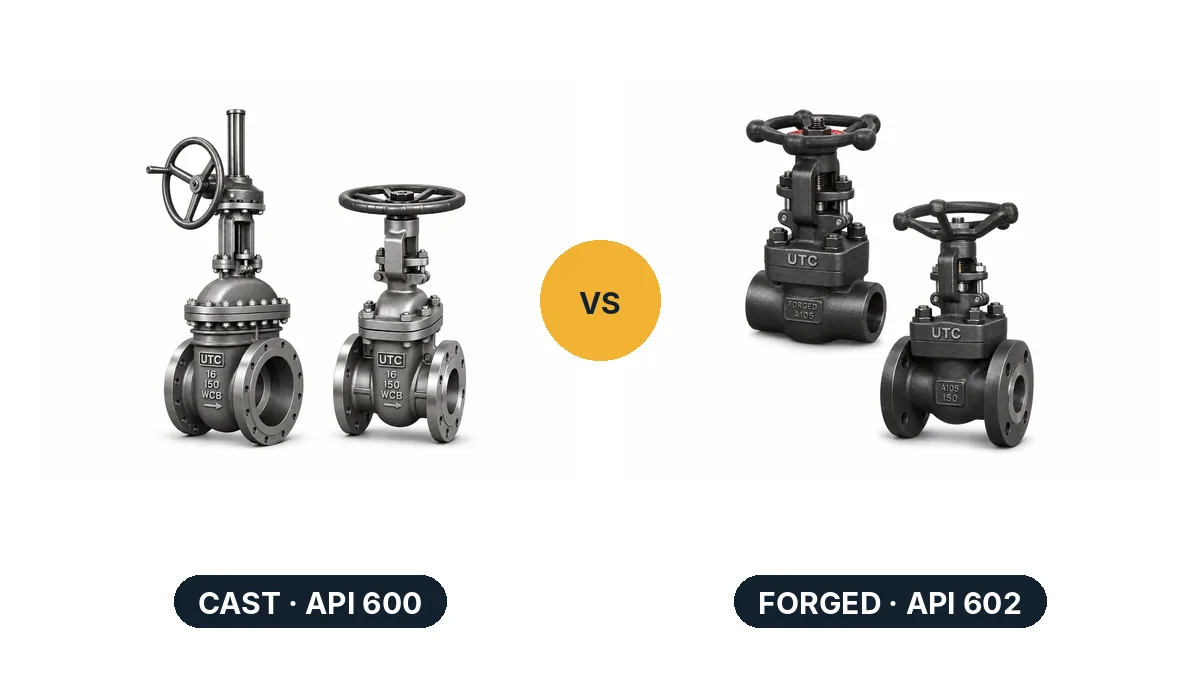
Gate valves are widely used for isolation on manifolds, tank farm lines and process piping because of their low pressure drop when open. They are typically cast steel in larger sizes. For guidance, read how to select a gate valve or visit our gate valves page.
Ball valves
Ball valves are the usual choice for quarter-turn on-off duty in oil and gas lines. Full-bore designs support pigging in pipelines, and trunnion-mounted designs suit larger sizes and higher pressure classes. Pipeline valves are commonly specified to API 6D, while general-purpose steel ball valves may follow API 608 or equivalent project specifications. Our ball valves page shows the configurations supplied.
Globe valves, check valves and strainers
Globe valves handle regulation, bypass and utility duties. Check valves protect pumps and compressors from reverse flow, and the choice of type affects surge behaviour; see how to choose a check valve. Y-type strainers protect pumps, meters and control valves from debris, particularly during start-up. Browse our globe valves, check valves and strainers pages.
Safety valves and overpressure protection
Every pressure vessel, heat exchanger and pipeline section that could exceed its design pressure needs overpressure protection. Spring-loaded pressure relief valves are the most common device. Flanged steel relief valves are commonly built to API 526 and sized following API 520, with relieving scenarios defined using API 521. Read what safety relief valves are and how they work.
Special requirements in oil and gas
Sour service
Where hydrogen sulphide is present, materials must resist sulphide stress cracking. NACE MR0175 / ISO 15156 sets requirements for materials in H2S-containing environments. The specification must say whether sour service applies, because it limits hardness and material selection.
Fire safety
Hydrocarbon lines usually require valves that remain safe in a fire. Fire-test standards such as API 607, API 6FA and ISO 10497 are referenced in many specifications. Confirm whether the valve design has been tested and what documentation exists.
Fugitive emissions
Stem and body seals must limit leakage to atmosphere. Standards such as ISO 15848-1 define test methods and classes; projects may require them for certain services.
Low temperature and offshore conditions
Cold services need low-temperature steel grades such as ASTM A352 LCB or LCC, and offshore environments need protection against corrosion. Specify the minimum design metal temperature and coating requirements.
Standards commonly cited in oil and gas
| Standard | Subject |
|---|---|
| API 600 | Steel gate valves, bolted bonnets |
| API 602 | Compact gate, globe and check valves, NPS 4 and smaller |
| API 6D | Pipeline and piping valves |
| API 598 | Valve inspection and testing |
| API 526 / 520 / 521 | Pressure relief valves, sizing and relieving scenarios |
| ASME B16.34 | Pressure–temperature ratings |
| NACE MR0175 / ISO 15156 | Materials for H2S-containing environments |
Documentation and traceability
Oil and gas projects usually require full material traceability. Typical documents include material test certificates, hydrostatic test reports, positive material identification where specified, and inspection records. Ask your supplier what is available for each order and agree the inspection plan before purchase. See our quality and standards page.
Onshore and offshore selection differences
Offshore platforms add constraints that onshore plants rarely face. Weight and space are limited, so compact designs are valued. Corrosion from salt-laden air and splash zones calls for suitable coatings or corrosion-resistant materials, and stainless steel or duplex grades may be specified for seawater services. Maintenance windows are short, so valves are chosen for reliability and long service intervals. Onshore facilities are generally more tolerant of size and weight but may face dust, extreme ambient temperatures and larger-diameter lines.
Planning for shutdowns and spares
Valve failures in oil and gas often show up during shutdowns, when the cost of delay is highest. Good practice is to identify critical valves early, hold or arrange spares for them, and agree lead times in advance. Standardising on a limited number of valve designs and trims across a site also reduces the spares inventory. Share your requirements, including expected quantities for each size and class, when you send an enquiry, so that availability can be confirmed early.
Gate valve or ball valve for isolation?
Both are used for isolation, and the choice is often set by the piping class. Ball valves operate quickly, seal tightly and offer full-bore flow, which makes them the natural choice for pipeline sections, launchers and receivers, and for emergency isolation where speed matters. Gate valves are typically preferred where the line is isolated rarely, where the bore must be straight-through in larger sizes and higher classes, and where the project specification prefers a rising-stem indication of position.
Neither is better in every case. Ask which duty the valve performs, how often it moves, how quickly it must close and what leakage standard the process needs. Those answers usually point to one type. Where a specification leaves both open, state your preference with the reason, so that quotations compare like with like.
Typical configurations in practice
- Wellhead and manifold areas: gate valves for isolation, with check valves on injection lines.
- Pipeline launchers and receivers: full-bore ball valves, so that pigs can pass.
- Compressor stations: check valves chosen for low slam, with safety valves on discharge vessels.
- Tank farms and terminals: gate valves for isolation and check valves on pump discharge, with strainers on pump suction.
- Refining units: cast steel gate, globe and check valves, forged valves on small-bore lines and pressure seal valves in hot, high-pressure services.
These are common patterns rather than fixed rules. Each facility’s piping classes define what is actually installed.
Supporting oil and gas buyers
Visit the oil and gas industry page to see how our valve range maps to these applications. When you are ready, send your data sheet through Request a Quote.
Frequently asked questions
Which valve is most common in oil and gas pipelines?
Full-bore ball valves and gate valves are widely used for isolation, with check valves for backflow protection.
What standard covers pipeline valves?
API 6D is the standard commonly cited for pipeline and piping valves.
What is sour service?
An environment containing hydrogen sulphide, which requires materials that resist sulphide stress cracking, as outlined in NACE MR0175 / ISO 15156.
Do oil and gas valves need fire-safe design?
Many hydrocarbon services do. Check the project specification and confirm test documentation with the supplier.
References and further reading
Standards and codes are published by their issuing bodies. Always use the current edition named in your project specification.