Globe Valves Manufacturer – Industrial Globe Valves
Globe valves are linear-motion valves used to start, stop and regulate flow.
About our globe valves
Globe valves are linear-motion valves used to start, stop and regulate flow. Their disc moves perpendicular to a seat, so the opening changes progressively with stem travel. This makes globe valves a common choice where controlled flow and reliable shut-off are both needed. UTC VALVES manufactures and supplies globe valves for throttling and regulating duties across process and utility systems.
Product specifications
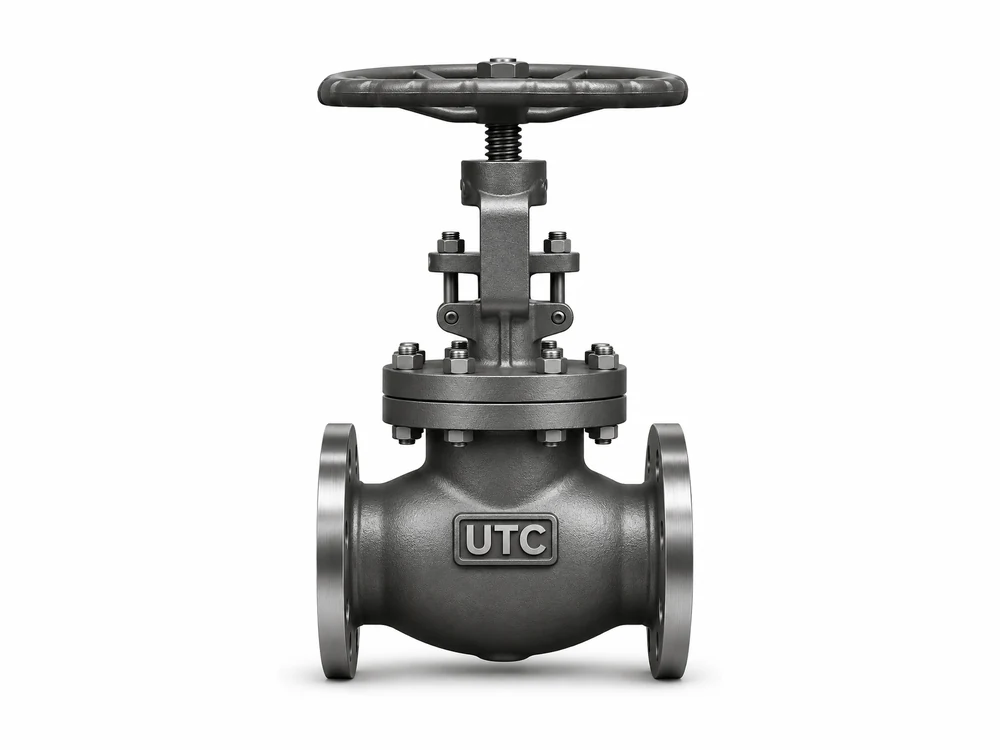
Cast steel globe valve
| Body material | WCB / WC6 / LCB / CF8 / CF8M / CF3 / CF3M etc. |
|---|---|
| Pressure rating | Class 150 to 2500 |
| Design standard | BS 1873 / ASME B16.34 |
| Inspection & testing | API 598 / BS EN 12266-1 |
| End connection | Flanged / butt weld / RTJ |
| Operation | Handwheel, gear or actuated (pneumatic / electric) |
| Size range | 2″ to 20″ |
| Disc types | Ball type or needle type disc |
| Options | Bypass, floor stand, extended stem |
| Dimensions | Face-to-face ASME B16.10; flanges ASME B16.5; butt-weld ends ASME B16.25 |
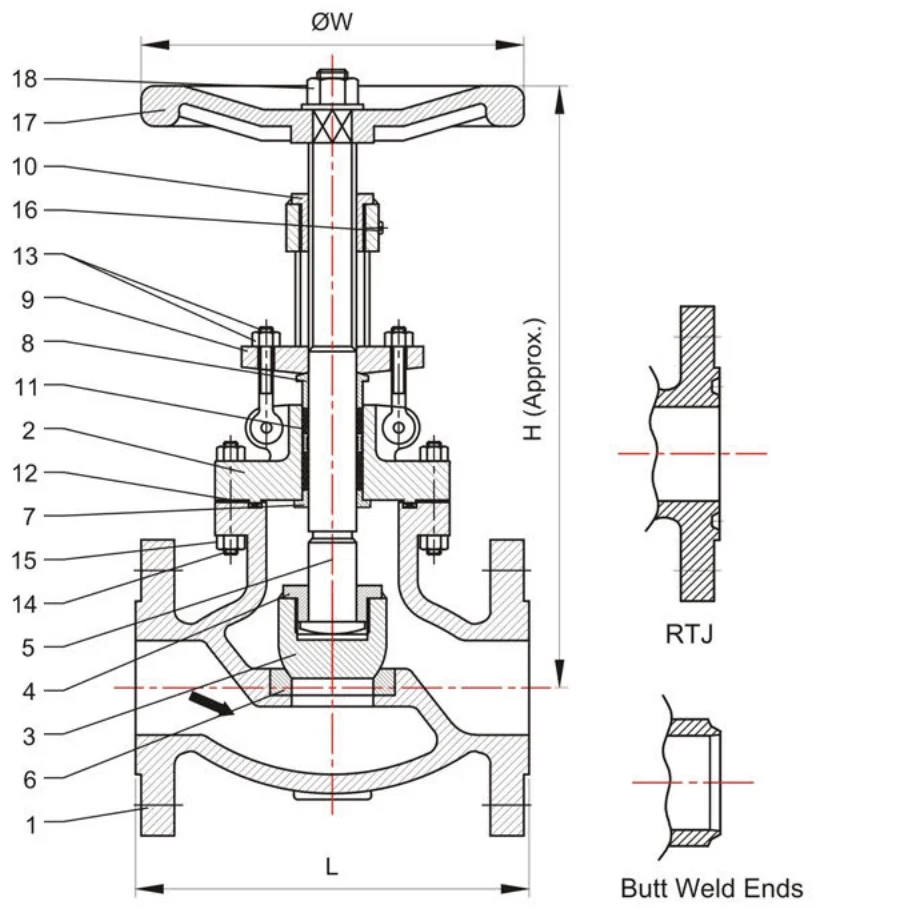
Dimensions & technical details (mm)
| Parameter | Class | 2″ | 3″ | 4″ | 5″ | 6″ | 8″ | 10″ | 12″ | 14″ | 16″ | 18″ | 20″ |
|---|---|---|---|---|---|---|---|---|---|---|---|---|---|
| Face to face, flanged (L) | 150# | 203 | 241 | 292 | 356 | 406 | 495 | 622 | 699 | 787 | 914 | 978 | 978 |
| 300# | 267 | 318 | 355 | 400 | 444 | 558 | 622 | 711 | 762 | 838 | 914 | 990 | |
| 600# | 292 | 355 | 431 | 508 | 558 | 660 | 787 | 838 | 889 | 991 | 1092 | 1194 | |
| 900# | 368 | 381 | 457 | 559 | 610 | 737 | 838 | 965 | 1029 | 1130 | 1219 | 1321 | |
| 1500# | 368 | 470 | 546 | 673 | 705 | 832 | 991 | 1130 | 1257 | 1384 | 1537 | 1664 | |
| Height (H) approx. | 150# | 330 | 410 | 475 | 540 | 585 | 725 | 825 | 940 | 1200 | 1270 | 1300 | 1350 |
| 300# | 350 | 485 | 520 | 565 | 655 | 825 | 920 | 1155 | 1250 | 1295 | 1340 | 1385 | |
| 600# | 420 | 550 | 590 | 620 | 700 | 950 | 1140 | 1320 | 1350 | 1350 | 1480 | 1500 | |
| 900# | 495 | 600 | 655 | 670 | 780 | 1050 | 1300 | 1480 | 1510 | 1630 | 1700 | 1725 | |
| 1500# | 550 | 625 | 750 | 810 | 925 | 1225 | 1450 | 1500 | 1620 | 1710 | 1760 | 1800 | |
| Handwheel dia. (ØW) | 150# | 200 | 250 | 300 | 350 | 350 | 450 | 500 | 600 | 600 | 650 | 650 | 700 |
| 300# | 200 | 300 | 300 | 350 | 350 | 500 | 600 | 700 | 700 | 450* | 500* | 550* | |
| 600# | 250 | 300 | 350 | 500 | 500 | 600 | 600 | 400* | 450* | 500* | 550* | 550* | |
| 900# | 300 | 350 | 500 | 500 | 350* | 350* | 400* | 400* | 450* | 500* | 500* | 550* | |
| 1500# | 300 | 400 | 450 | 500 | 600* | 450* | 500* | 500* | 550* | 550* | 600* | 600* | |
| Weight (kg) approx. | 150# | 23 | 40 | 65 | 95 | 115 | 180 | 280 | 385 | 550 | 780 | 1050 | 1225 |
| 300# | 30 | 55 | 95 | 135 | 180 | 260 | 375 | 525 | 760 | 1135 | 1470 | 1680 | |
| 600# | 40 | 72 | 132 | 210 | 245 | 460 | 700 | 1100 | 1600 | 1955 | 2075 | 2150 | |
| 900# | 96 | 117 | 178 | 305 | 355 | 730 | 1050 | 1350 | 2170 | 2535 | 3930 | 5120 | |
| 1500# | 116 | 145 | 210 | 395 | 475 | 925 | 1365 | 1950 | – | – | – | – |
Material list
| No. | Part | Material (ASTM specification) |
|---|---|---|
| 1 | Body | WCB / WC6 / WC9 / CF8 / CF8M / CF3 / CF3M / LCB |
| 2 | Cover | WCB / WC6 / WC9 / CF8 / CF8M / CF3 / CF3M / LCB |
| 3 | Disc / plug | WCB / WC6 / WC9 / CF8 / CF8M / CF3 / CF3M / LCB |
| 4 | Disc nut | SS 410 / SS 304 / SS 304L / SS 316L |
| 5 | Stem | SS 410 / SS 304 / SS 304L / SS 316L |
| 6 | Seat ring | SS 410 / SS 304 / SS 304L / SS 316L |
| 7 | Back seat bush | SS 410 / SS 304 / SS 304L / SS 316L |
| 8 | Gland | SS 410 / SS 304 / SS 304L / SS 316L |
| 9 | Gland flange | WCB / WC6 / WC9 / CF8 / CF8M / CF3 / CF3M / LCB |
| 10 | Stem nut | A439 Gr. D2 / Al Bronze |
| 11 | Gland packing | Graphoil / Graphite Asbestos / PTFE |
| 12 | Bonnet gasket | Spiral Wound Graphoil + SS 316 |
| 13 | Gland eye bolt & nut | Carbon Steel / Stainless Steel |
| 14 | Bonnet stud | B7 / B7M / B8M / B8 / L7 |
| 15 | Bonnet nut | 2H / 8 / 8M / 7 |
| 16 | Grub screw | Carbon Steel |
| 17 | Handwheel | Carbon Steel |
| 18 | Handwheel nut | Carbon Steel |
We also offer Inconel 625, Super Duplex Gr. 5A & 6A and Nickel Al. Bronze MOC.
How it works
Fluid enters the body, changes direction and passes through the seat opening. As the stem lowers the disc onto the seat, the flow area reduces until the valve closes. Because flow changes direction inside the body, globe valves have a higher pressure drop than gate or ball valves – the trade-off for good throttling capability.
Types and configurations
- Z-pattern (standard) body – the most common configuration
- Y-pattern body – straighter flow path with lower pressure drop
- Angle pattern – flow turns 90°, replacing an elbow and a valve
- Stop-check (non-return) globe valves
- Bellows-sealed globe valves for applications requiring improved stem sealing
Construction and design features
- Plug, flat or parabolic disc profiles for different control characteristics
- Guided stem and disc for stable throttling
- Short stem travel compared with gate valves
- Seat and disc can often be lapped or replaced in maintenance
- Handwheel, gear or actuator operation
Materials of construction
- Cast carbon steel (e.g. ASTM A216 WCB)
- Cast stainless steel (e.g. ASTM A351 CF8/CF8M)
- Alloy steel (e.g. ASTM A217 WC6/WC9) for high-temperature steam
- Forged steel bodies on small sizes (e.g. ASTM A105)
- Hard-faced seat and disc trims for erosive or high-temperature service
Material grades listed are those commonly specified in industry for this valve type. Availability of each grade is subject to confirmation by UTC VALVES for every enquiry.
End connections
- Flanged RF or RTJ ends
- Butt-weld ends
- Socket-weld and threaded ends on small-bore valves
Pressure classes and standards
Pressure classes offered by UTC VALVES: listed for each model in the product specifications below.
Standards commonly referenced for this valve type include API 623 (steel globe valves), BS 1873, ASME B16.34 and API 598. These are industry references; they do not indicate that UTC VALVES or its products hold certification. Compliance documents are provided per order where available.
Industrial applications
- Flow regulation and throttling
- Boiler feedwater and steam lines
- Control valve bypass lines
- Fuel oil and lubricating oil systems
- Drain and vent duties
Industries served
- Power generation
- Oil & gas
- Refining & petrochemicals
- Chemical processing
- Marine & shipbuilding
Information to include in your enquiry
A complete enquiry helps us respond with an accurate offer for globe valves:
- Valve type and configuration
- Nominal size (NPS / DN)
- Pressure class or rating
- Body, trim and seat materials
- End connection and facing
- Operator: lever, handwheel, gear or actuator
- Service fluid, design pressure and temperature
- Applicable standard or project specification
- Quantity and required delivery date
- Inspection, testing and documentation requirements (e.g. material test certificates, third-party inspection)
Globe Valves: frequently asked questions
Why does a globe valve have a higher pressure drop?
The fluid changes direction as it passes through the seat. Those direction changes create resistance. Y-pattern and angle bodies reduce this effect.
Which way should a globe valve be installed?
Follow the flow arrow cast or marked on the body. Many globe valves are designed for flow under the seat, but the correct orientation depends on the specific design.
When should I choose a globe valve instead of a gate valve?
Choose a globe valve when you need to regulate flow or operate the valve frequently. Choose a gate valve for full-bore isolation with minimal pressure loss.
Related valve categories
Request a quote for globe valves
Send your specification, datasheet or bill of materials. Our team reviews every enquiry and responds with availability and a quotation.