Gate Valves Manufacturer – Industrial Gate Valves
Gate valves are linear-motion isolation valves.
About our gate valves
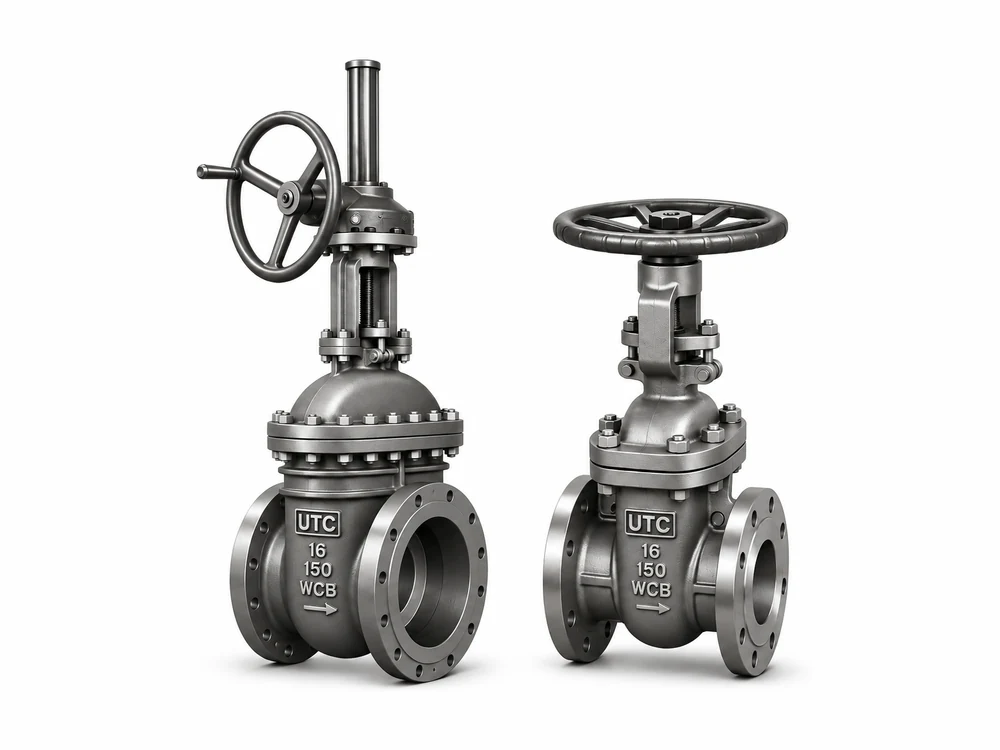
Gate valves are linear-motion isolation valves. A wedge or parallel gate moves at right angles to the flow to fully open or fully close the line. When fully open, the gate is withdrawn from the flow path, giving a straight-through bore with low pressure drop. UTC VALVES manufactures and supplies gate valves for on/off isolation duty in process, pipeline and utility services.
Product specifications
Cast steel gate valve
| Body material | WCB / WC6 / LCB / CF8 / CF8M / CF3 / CF3M etc. |
|---|---|
| Pressure rating | Class 150 to 2500 |
| Design standard | API 600 / BS 1414 / ASME B16.34 |
| Inspection & testing | API 598 / BS EN 12266-1 |
| End connection | Flanged / butt weld / RTJ |
| Operation | Handwheel, gear or actuated (pneumatic / electric) |
| Size range | 2″ to 24″ |
| Trim | As per requirement |
| Options | Bypass, floor stand, extended stem |
| Dimensions | Face-to-face ASME B16.10; flanges ASME B16.5; butt-weld ends ASME B16.25 |
| Versions | IBR / non-IBR (as per UTC VALVES catalogue) |
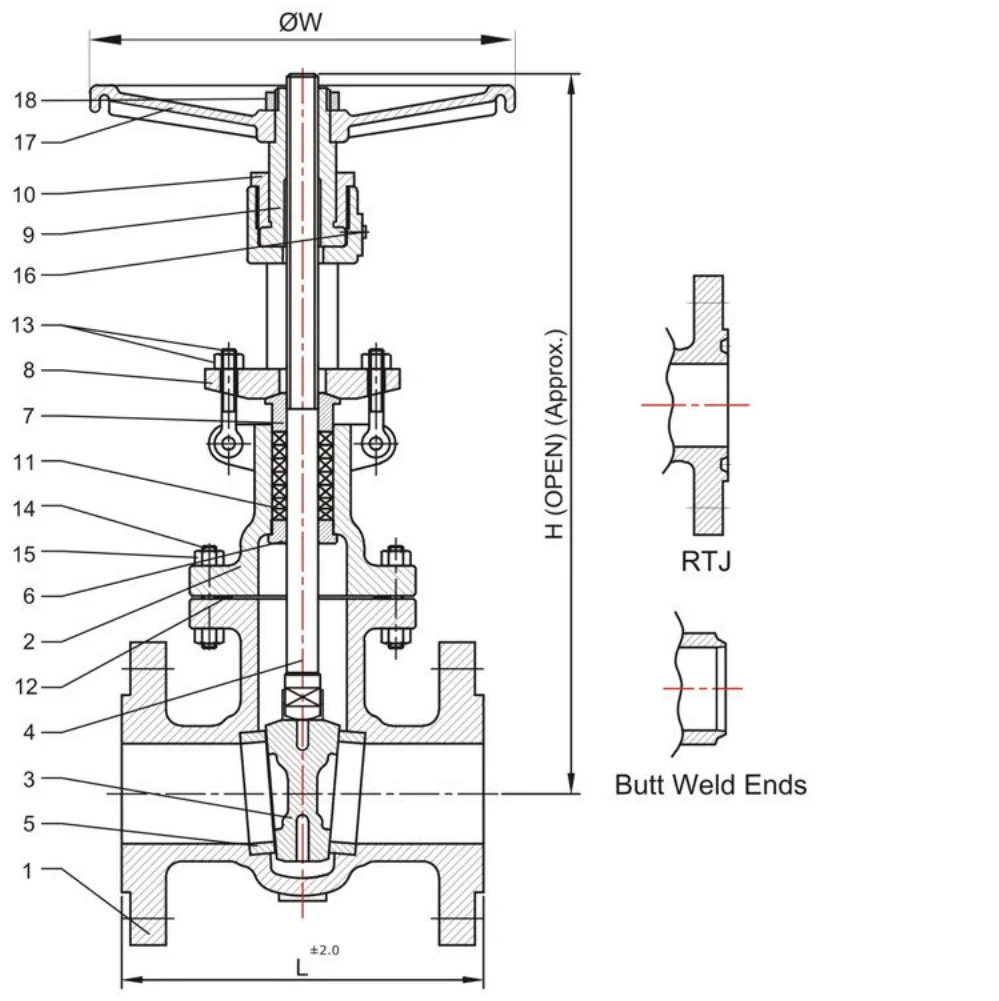
Dimensions & technical details (mm)
| Parameter | Class | 2″ | 3″ | 4″ | 5″ | 6″ | 8″ | 10″ | 12″ | 14″ | 16″ | 18″ | 20″ | 24″ |
|---|---|---|---|---|---|---|---|---|---|---|---|---|---|---|
| Face to face (L) | 150# | 178 | 203 | 229 | 254 | 267 | 292 | 330 | 356 | 381 | 406 | 432 | 457 | 508 |
| 300# | 216 | 283 | 305 | 381 | 403 | 419 | 457 | 502 | 762 | 838 | 914 | 990 | 1143 | |
| 600# | 292 | 356 | 432 | 508 | 559 | 660 | 787 | 838 | 889 | 991 | 1092 | 1194 | 1397 | |
| 900# | 368 | 381 | 457 | 559 | 610 | 737 | 838 | 965 | 1029 | 1130 | 1219 | 1321 | – | |
| 1500# | 368 | 470 | 546 | 673 | 705 | 832 | 991 | 1130 | 1257 | 1384 | 1537 | 1664 | – | |
| Height (H) approx. | 150# | 375 | 470 | 570 | 705 | 790 | 990 | 1200 | 1400 | 1500 | 1740 | 1950 | 2150 | 2565 |
| 300# | 400 | 500 | 600 | 715 | 850 | 1025 | 1260 | 1450 | 1580 | 1790 | 2100 | 2250 | 2654 | |
| 600# | 400 | 540 | 635 | 730 | 875 | 1040 | 1280 | 1470 | 1580 | 1905 | 2010 | 2275 | 3150 | |
| 900# | 445 | 595 | 750 | 765 | 865 | 1225 | 1450 | 1625 | 1680 | 1925 | 2025 | 2310 | – | |
| 1500# | 475 | 600 | 775 | 785 | 925 | 1250 | 1525 | 1725 | 1750 | 1950 | 2125 | 2310 | – | |
| Handwheel dia. (ØW) | 150# | 200 | 230 | 250 | 280 | 300 | 350 | 450 | 450 | 500 | 500 | 600 | 600 | 686 |
| 300# | 200 | 230 | 250 | 300 | 350 | 400 | 450 | 500 | 500 | 600 | 680 | 680 | 762 | |
| 600# | 200 | 250 | 305 | 400 | 450 | 450 | 500 | 600 | 600 | 760 | 760 | 760 | 762 | |
| 900# | 300 | 300 | 400 | 450 | 300* | 350* | 400* | 400* | 450* | 500* | 500* | 550* | – | |
| 1500# | 300 | 300* | 300* | 300* | 350* | 350* | 400* | 400* | 450* | 500* | 550* | 550* | – | |
| Weight (kg) approx. | 150# | 21 | 35 | 52 | 35 | 85 | 135 | 205 | 300 | 400 | 520 | 685 | 900 | 1410 |
| 300# | 25 | 50 | 75 | 50 | 155 | 230 | 350 | 490 | 745 | 950 | 1300 | 1640 | 2460 | |
| 600# | 40 | 65 | 115 | 65 | 250 | 410 | 650 | 1100 | 1600 | 1950 | 2070 | 2150 | 3620 | |
| 900# | 85 | 125 | 180 | 260 | 310 | 525 | 975 | 1450 | 1900 | 2555 | 3275 | 3900 | – | |
| 1500# | 110 | 145 | 220 | 320 | 403 | 710 | 1350 | 2300 | 3100 | 3575 | 4585 | 5000 | – |
Material list
| No. | Part | Material (ASTM specification) |
|---|---|---|
| 1 | Body | WCB / WC6 / WC9 / CF8 / CF8M / CF3 / CF3M / LCB |
| 2 | Bonnet | WCB / WC6 / WC9 / CF8 / CF8M / CF3 / CF3M / LCB |
| 3 | Wedge | WCB / WC6 / WC9 / CF8 / CF8M / CF3 / CF3M / LCB |
| 4 | Stem | SS 410 / SS 304 / SS 304L / SS 316L |
| 5 | Seat ring | SS 410 / SS 304 / SS 304L / SS 316L |
| 6 | Back seat bush | SS 410 / SS 304 / SS 304L / SS 316L |
| 7 | Gland | SS 410 / SS 304 / SS 304L / SS 316L |
| 8 | Gland flange | WCB / WC6 / WC9 / CF8 / CF8M / CF3 / CF3M / LCB |
| 9 | Stem nut | A439 Gr. D2 / Al Bronze |
| 10 | Lock nut | Carbon Steel / SS 304 |
| 11 | Gland packing | Graphoil / Graphite Asbestos / PTFE |
| 12 | Bonnet gasket | Spiral Wound SS 304 with Graphoil or Asbestos / Octagonal Ring |
| 13 | Gland eye bolt & nut | Carbon Steel / Stainless Steel |
| 14 | Bonnet stud | B7 / B7M / B8M / B8 / L7 |
| 15 | Bonnet nut | 2H / 8 / 8M / 7 |
| 16 | Grub screw | Carbon Steel |
| 17 | Handwheel | Carbon Steel |
| 18 | Handwheel nut | Carbon Steel |
How it works
Turning the handwheel (or gear/actuator) drives the stem, which raises or lowers the gate between two seats. Line pressure pushes the gate against the downstream seat to create the seal. Gate valves are designed for fully open or fully closed service; partly open gates are exposed to high-velocity flow that can cause vibration and seat erosion.
Types and configurations
- Solid wedge – simple, robust design for general service
- Flexible wedge – accommodates seat distortion from thermal or piping loads, reducing the risk of sticking
- Split wedge / parallel slide – two-piece gates for specific sealing and thermal conditions
- Rising stem, outside screw & yoke (OS&Y) – stem position shows valve status
- Non-rising stem – for installations with limited height
- Bolted bonnet, welded bonnet and pressure seal bonnet constructions
Construction and design features
- Full-bore, straight-through flow path when open
- Backseat arrangement that allows packing maintenance under defined conditions (design-dependent)
- Renewable or hard-faced seat rings, depending on design
- Handwheel, gear operator or actuator mounting options
- Yoke-mounted stem nut for smooth operation
Materials of construction
- Cast carbon steel (e.g. ASTM A216 WCB, a commonly specified grade)
- Cast stainless steel (e.g. ASTM A351 CF8M)
- Low-temperature carbon steel (e.g. ASTM A352 LCB/LCC)
- Chrome-moly alloy steel (e.g. ASTM A217 WC6/WC9) for high-temperature service
- Trim options such as 13Cr stainless or hard-faced seats
Material grades listed are those commonly specified in industry for this valve type. Availability of each grade is subject to confirmation by UTC VALVES for every enquiry.
End connections
- Flanged – raised face (RF) or ring-type joint (RTJ), commonly to ASME B16.5 / B16.47
- Butt-weld ends, commonly to ASME B16.25
- Socket-weld or threaded ends on small sizes
Pressure classes and standards
Pressure classes offered by UTC VALVES: listed for each model in the product specifications below.
Standards commonly referenced for this valve type include API 600 (steel gate valves), API 603 (corrosion-resistant bolted bonnet gate valves), ASME B16.34 (pressure–temperature ratings), ASME B16.10 (face-to-face) and API 598 (inspection and testing). These are industry references; they do not indicate that UTC VALVES or its products hold certification. Compliance documents are provided per order where available.
Industrial applications
- Pipeline and manifold isolation
- Tank farm inlet and outlet lines
- Steam, condensate and boiler auxiliary lines
- Cooling water and fire water headers
- Hydrocarbon process isolation
Industries served
- Oil & gas
- Refining & petrochemicals
- Power generation
- Water & wastewater
- Chemical processing
Information to include in your enquiry
A complete enquiry helps us respond with an accurate offer for gate valves:
- Valve type and configuration
- Nominal size (NPS / DN)
- Pressure class or rating
- Body, trim and seat materials
- End connection and facing
- Operator: lever, handwheel, gear or actuator
- Service fluid, design pressure and temperature
- Applicable standard or project specification
- Quantity and required delivery date
- Inspection, testing and documentation requirements (e.g. material test certificates, third-party inspection)
Gate Valves: frequently asked questions
Can a gate valve be used to throttle flow?
No. Gate valves are intended for fully open or fully closed service. Throttling causes high-velocity flow under the gate, which can lead to vibration, noise and seat damage. For flow regulation, consider a globe valve.
What is the difference between a solid wedge and a flexible wedge?
A solid wedge is a single rigid piece suited to general service. A flexible wedge has a cut around its perimeter so it can flex slightly, which helps it seat properly when the valve body is distorted by temperature changes or pipe loads.
Which details should I include in a gate valve enquiry?
Size, pressure class, body and trim material, end connection, operator type, service fluid, design temperature and the applicable design standard or project specification.
Related valve categories
Request a quote for gate valves
Send your specification, datasheet or bill of materials. Our team reviews every enquiry and responds with availability and a quotation.